
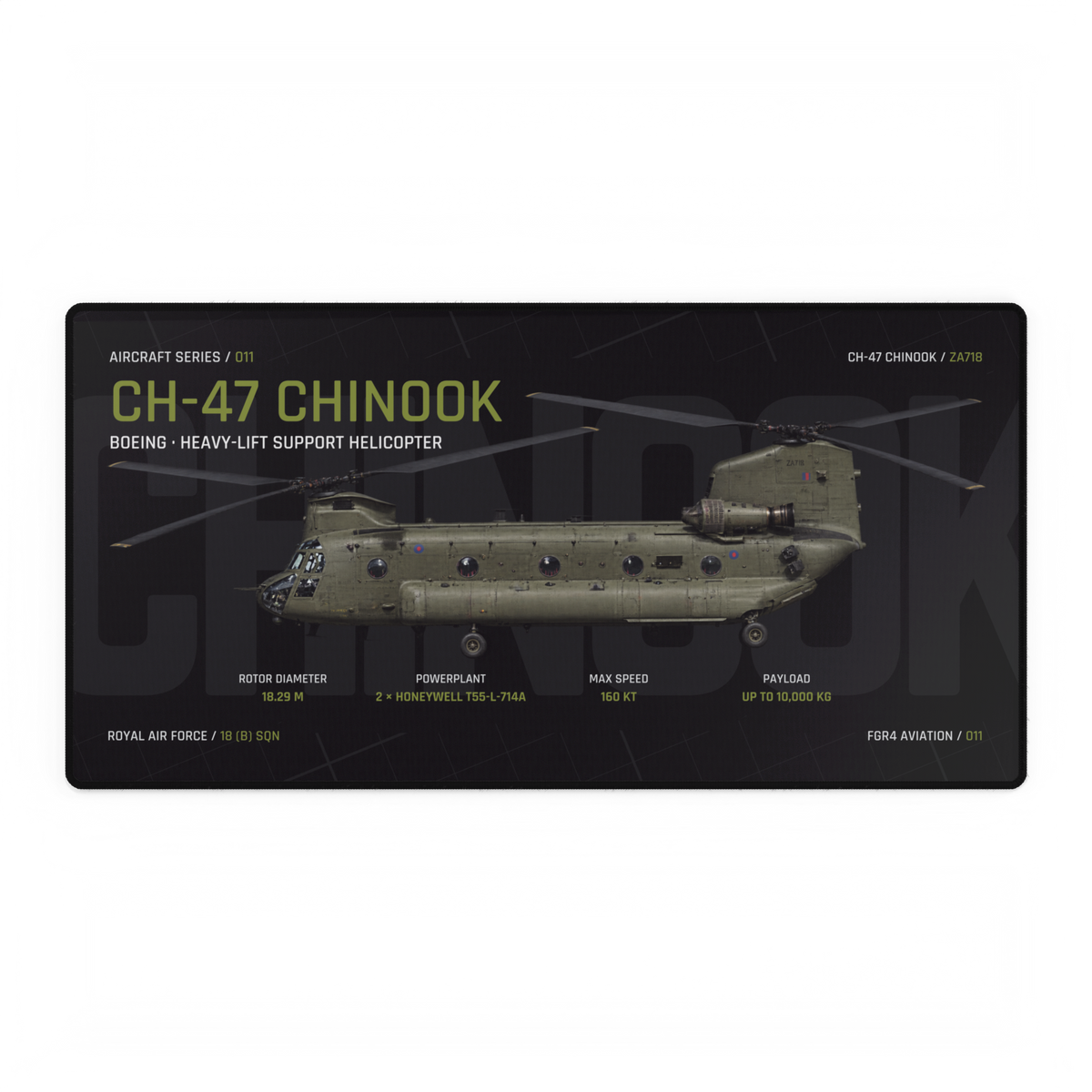
The Chinook has two large rotors because a tandem pair solves two jobs at once: both rotor systems produce lift, and their opposite rotation cancels the torque reaction that a conventional single-main-rotor helicopter controls with a tail rotor. That is why the Chinook can have a long cargo fuselage with a rotor above each end and no small vertical tail rotor.
For an aviation enthusiast trying to read the shape, the important phrase is tandem rotor. The forward rotor sits above the front of the fuselage; the aft rotor sits higher on the rear pylon. Together they create the silhouette that makes a CH-47 recognisable before any markings are visible.
One main rotor creates a torque problem
A powered rotor turns in one direction, while an equal and opposite reaction tries to turn the helicopter fuselage the other way. The FAA Helicopter Flying Handbook explains that most helicopter designs use an anti-torque or tail rotor to counter that reaction and control heading.
A tandem-rotor helicopter uses a different answer. The FAA states that the two rotor systems turn in opposite directions, so their torque reactions counteract one another instead of relying on a tail rotor. The Chinook still has directional controls; it simply creates and manages yaw through its tandem system rather than a separate tail rotor.
The Chinook’s rotors are a connected system
The two discs are not independent propellers placed at opposite ends. RAF engineering material in Air Clues describes the Chinook’s forward and aft transmissions, combining transmissions and connecting shafts as the path that transfers engine power to its synchronised, contra-rotating tandem rotors.
That word synchronised matters visually. From above, the two rotor discs occupy overlapping areas. Their blade relationship is mechanically controlled as part of the drive system. In a side view, the forward hub is lower and the aft hub is raised; the swept blade paths frame the long cabin between them.
A large lifting rotor sits above the forward fuselage. Its rotation creates a torque reaction in the airframe.
A second lifting rotor sits on the raised rear pylon and turns in the opposite direction.
The opposite torque reactions counter each other, so the aircraft does not need a conventional anti-torque tail rotor.
This is an editorial simplification of the layout, not a flight-control diagram. It explains why the two turning directions belong together; it does not show the full transmission, control or rotor-aerodynamics system.
Why the layout suits a transport helicopter
The arrangement places a lifting rotor above each end of the long fuselage rather than reserving the tail for an anti-torque rotor. Boeing’s historical account traces the Chinook to the YHC-1B tandem-rotor transport helicopter rolled out in 1961. The basic relationship between the long cabin and its two rotor pylons has remained the type’s defining form.
The current RAF Chinook profile describes the aircraft as a versatile heavy-lift support helicopter used for troop transport, resupply and casualty evacuation. It lists an 18.29 m rotor diameter and a 30.14 m overall length. Those figures help explain the visual scale: each rotor disc is broad, while the two hubs are separated along a fuselage built around carrying people and freight.
The RAF page also records the current aircraft’s two engines. Two engines should not be confused with two rotors: the engineering point is that the drive system distributes power through connected transmissions and shafts to the forward and aft rotor systems.
How to recognise the tandem layout
Use this four-part checklist when reading a photograph, silhouette or side-profile design:
- Find the forward pylon. The first hub sits above the cockpit end of the fuselage rather than at its centre.
- Find the raised rear pylon. The aft hub sits high above the rear fuselage, giving the aircraft its stepped upper line.
- Trace both rotor discs. The two large three-blade systems span the forward and rear halves of the aircraft.
- Check the tail. There is no small side-facing tail rotor. The aft rotor is another full lifting rotor, not an anti-torque propeller.
Viewpoint changes how obvious those clues are. A side profile separates the two hubs and exposes the long cabin; a top view makes the two rotor discs and their overlap easier to understand. Our guide to aircraft side, top and front views explains what each viewpoint reveals.
Read the system in the owned artwork
The owned hero above shows the live CH-47 Chinook Aircraft Desk Mat in its Night Edition. The side profile clearly separates the forward hub from the raised aft pylon, shows the paired three-blade rotor systems and leaves the tail free of a conventional anti-torque rotor. Both Night and Studio variants were available when checked for this guide.
The artwork is useful because it strips the recognition problem down to the aircraft’s strongest structural cues. If you are comparing its light and dark backgrounds, the Night-versus-Studio edition guide provides a four-question choice test. If you are choosing between one aircraft and a broader line-up, the single-aircraft versus fleet guide separates those two display jobs.
Browse the live Aircraft Series to compare the Chinook’s tandem-rotor outline with fixed-wing profiles. Start with the hub positions and missing tail rotor: once those three cues register, the Chinook is difficult to mistake for anything else.
Sources and product availability checked 8 October 2026. Technical basis: FAA Helicopter Flying Handbook; Royal Air Force Chinook profile; RAF Safety Centre Air Clues issue 45; Boeing historical product overview. Hero image: owned FGR4 CH-47 Chinook Aircraft Desk Mat Night Edition artwork showing RAF Chinook ZA718 in side profile. The three-part card is an editorial simplification, not an engineering or operating reference.