
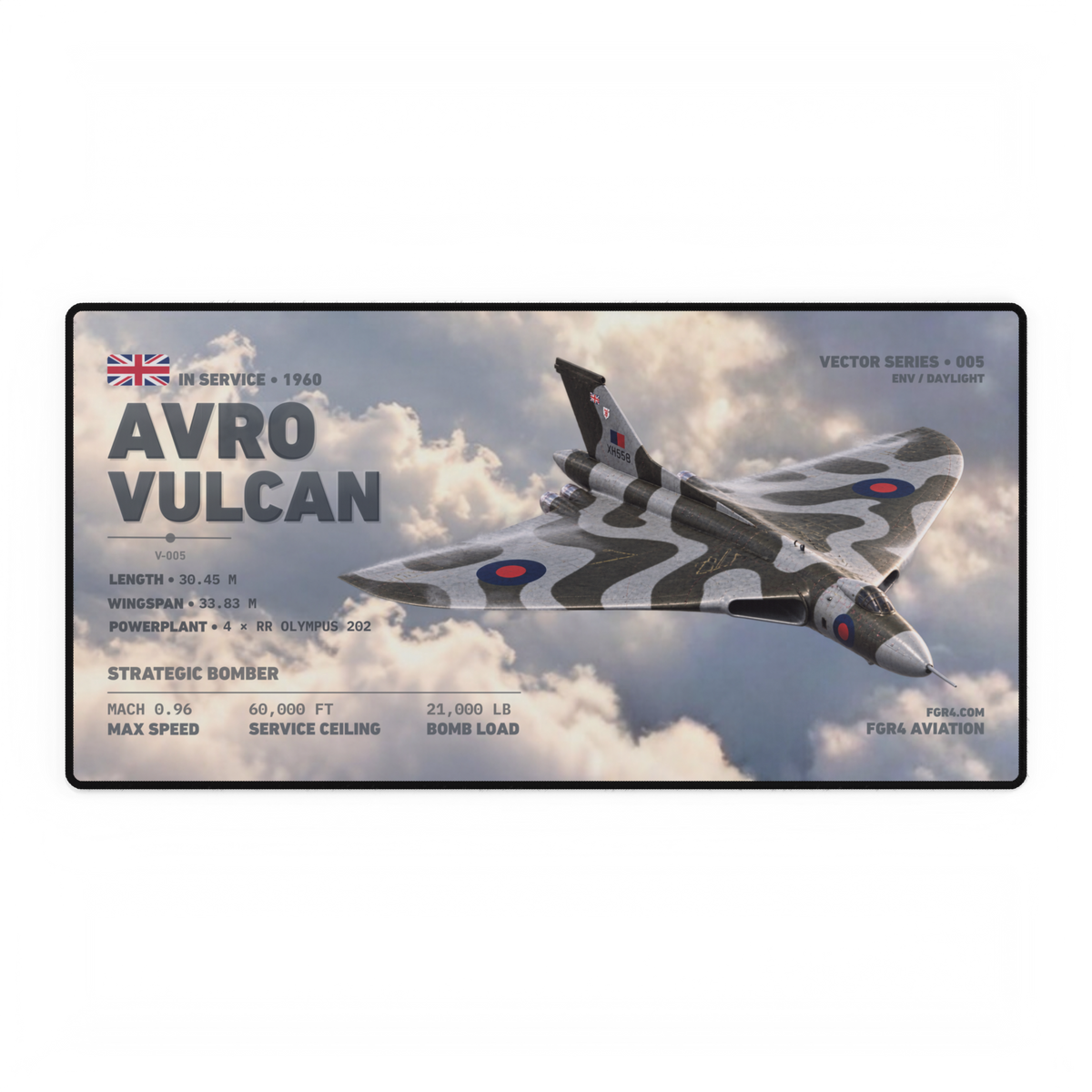
The Avro Vulcan is easiest to recognise from above. Its wing does not read as a narrow surface attached to a separate tube-like fuselage; the aircraft appears as one broad triangle, with the nose projecting from the front and a single fin rising at the rear.
That shape comes from its large tailless delta wing. “Tailless” means there is no separate horizontal tailplane behind the main wing. “Delta” describes the triangular planform. The combination gives the Vulcan its strongest recognition clue, but the intakes, nose and fin complete the silhouette.
Start with the triangle
The RAF Museum calls the large triangular wing the Vulcan’s most distinctive feature. Its history explains that Avro adopted a tailless delta layout while developing a new strategic bomber to meet Air Ministry Specification B.35/46. The original design used a 45-degree leading-edge angle, and smaller Avro 707 aircraft were built to gather data for the new configuration.
From a high three-quarter or top view, trace one leading edge from a wingtip towards the nose, then back out to the opposite tip. The broad planform fills most of that outline. A conventional tailplane does not interrupt the rear with another pair of horizontal surfaces.
The owned image used above comes from the live Avro Vulcan Vector Desk Mat. Its oblique view makes the triangular planform, forward nose and single vertical fin visible together. The printed figures on the artwork are not used as sources for this guide; the aircraft explanation comes from the museum and manufacturer records below.
Three clues that survive the angle
Look for a large triangular wing that dominates the planform rather than a narrow wing attached midway along a clearly separate fuselage.
At the front of each wing root, dark intake openings sit close to the fuselage. In a front or oblique view, they break the smooth leading edge.
Follow the broad wing rearwards to one vertical fin. There is no separate pair of horizontal tailplanes behind the delta.
Use the clues together. A triangular wing alone is not enough because many aircraft use some form of delta planform. On the Vulcan, the broad wing, paired intake areas and single fin create the recognisable sequence.
What changes between top, front and side views?
The Vulcan does not reveal the same information from every angle. The earlier guide to aircraft side, top and front views explains why recognition improves when you know what each projection preserves.
The delta is clearest here. Check the long leading edges, broad centre section and absence of a separate horizontal tailplane.
The triangle compresses into a wide span. Look for the low wing, intake openings near the centre and the fin above the airframe.
The full triangle becomes harder to see. Use the pointed nose, deep wing-root area and single fin, then confirm with another angle.
A pure side view can therefore be the least useful angle for identifying a delta. The live Vulcan B.2 Aircraft Desk Mat uses a side-profile technical layout, which is useful for studying the nose-to-fin line. Compare it with the oblique Vector view when you want to see how much information appears or disappears as the viewpoint changes.
Why does the fuselage look absorbed into the wing?
On the Vulcan, the wing is so broad at the centre that the fuselage and wing do not separate visually as sharply as they do on an aircraft with a slender straight wing. From above, the nose leads into a wide central mass before the outline runs out towards the wingtips. From the front, the intake openings sit close to that centre rather than hanging in pods below the wing.
This is a description of the visible shape, not a claim that the fuselage disappears structurally. The cockpit, nose, internal volume and engine installation remain distinct parts of the aircraft. For recognition, however, the eye reads the entire airframe as one large arrowhead-like planform.
The Vulcan wing was not frozen at the prototype stage
The clean triangle was refined during development. RAF Museum records that higher-speed buffeting led to a partial redesign, giving the production B.1 a kinked and dropped leading edge. BAE Systems Heritage similarly describes the “Phase 2 wing” with a kinked and drooped leading edge and vortex generators, tested first on the Avro 707A.
The later B.2 used a modified, larger wing. RAF Museum lists the B.2 at a 34-metre wingspan, compared with 30 metres for the prototype-era dimensions it gives for the B.1. Those changes matter if you are comparing exact variants, but they do not remove the central recognition clue: both still read as large tailless delta aircraft.
This is why the safest label for an uncertain image is often simply “Avro Vulcan” until the wing outline, serial and period details have been checked. A familiar overall silhouette does not automatically prove the precise variant.
Try the trace-the-outline test
Take a clear top or oblique image and ignore the markings, camouflage and printed labels. Trace only five points:
- the nose tip;
- the left wingtip;
- the left rear corner of the wing;
- the right rear corner of the wing;
- the right wingtip, returning to the nose.
If the resulting outline is dominated by one broad triangle and there is no separate horizontal tailplane, you have found the main Vulcan cue. Add the intake openings and single fin to move from “delta aircraft” to a stronger Vulcan identification.
The same method works on other silhouettes, but the clues change. The A-10 silhouette guide, for example, uses straight wings, high-mounted engines and twin fins. Comparing the two shows why recognition works best as a short stack of features rather than one vague impression.
How the silhouette changes in artwork
A wide desk format can show the Vulcan in side profile, from above or in a three-quarter scene. Each choice emphasises something different. Side profile preserves the long nose-to-fin line. A high oblique view exposes the delta. A front view makes the aircraft feel wide but compresses the triangle.
The current Aircraft Series uses the technical side-profile approach, while the Vector Series uses a more dynamic three-quarter treatment. Neither angle supplies every recognition clue on its own. Looking across both is a practical way to learn how viewpoint changes the same aircraft.
The wing is the first clue, not the whole answer
The Vulcan’s large tailless delta wing gives the aircraft its unmistakably broad planform. The intake openings near the wing roots and the single vertical fin turn that triangle into a more confident identification. From above, the answer is immediate; from the side, you need more supporting clues.
To inspect the delta in a high three-quarter composition, open the Avro Vulcan Vector Desk Mat and compare its full gallery with the side-profile Aircraft Series view.
Sources
- RAF Museum: The Avro Vulcan — Part 1
- RAF Museum: Avro Vulcan B2 collection record
- BAE Systems Heritage: Avro Vulcan
Aircraft and product sources checked 15 October 2026. Product artwork supports the visual exercise, while technical and historical claims come from the cited museum and manufacturer records. FGR4 Aviation is not presented as affiliated with or endorsed by the RAF Museum or BAE Systems.