
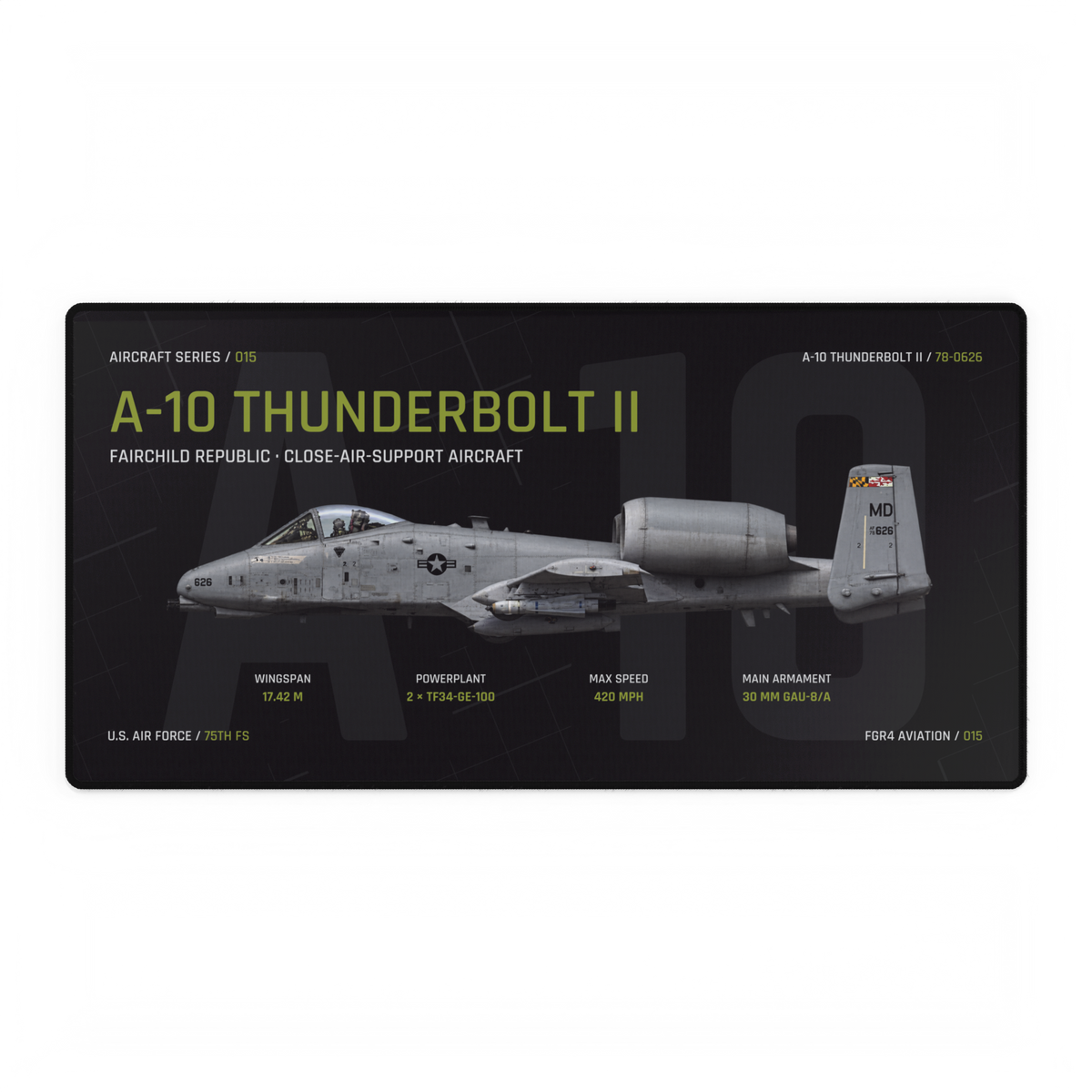
The A-10 Thunderbolt II is easy to recognise because several unusual shapes appear together: a broad straight wing, two large engine nacelles high on the rear fuselage, twin vertical tails and a blunt nose built around a prominent cannon installation. Remove the camouflage, unit marks and colour, and that four-part geometry still gives the aircraft away.
The useful skill is to read those structural clues in order. Start with the whole outline, then confirm it at the rear and nose. That method works on a photograph, a distant aircraft, a model or a side-profile illustration without relying on a nickname or a paint scheme.
Start with the wing-to-fuselage proportion
An official Air National Guard overview describes the A-10 as a straight-wing aircraft. The current U.S. Air Force A-10C fact sheet lists a wingspan of 57 feet 6 inches against a length of 53 feet 4 inches. In plan or front-quarter views, that span-to-length relationship gives the aircraft a broad, planted appearance.
Do not reduce the clue to “a wing without sweep”. Look at where the wing meets the fuselage and how much of the outline it occupies. The cockpit sits forward of the wing, as the USAF fact sheet records, while the long rear fuselage carries the engines and tail. In a clean side view, the wing divides those visually different forward and aft sections.
The engines sit where your eye does not expect them
The USAF identifies two General Electric TF34-GE-100 turbofans. Visually, the important point is their position: the nacelles sit high and aft, one on each side of the rear fuselage. They are not buried in the fuselage or slung beneath the wing like the engines on many familiar jets.
That position creates a strong side-profile cue. The upper line rises behind the wing into a large rounded engine nacelle before continuing towards the tail. From the front or rear, the nacelles appear as a separated pair above the fuselage line. If the wing is partly hidden, the engine placement can still identify the basic A-10 shape.
Use the twin tails as confirmation
The rear of the A-10 ends in two vertical stabilisers rather than one central fin. The USAF notes that the vertical stabilisers are among the aircraft’s interchangeable left-and-right parts. In silhouette, the fins sit wide apart near the ends of the horizontal tail, framing the rear view.
Twin tails alone are not enough; many military aircraft have two fins. The diagnostic combination is twin fins behind two high rear-mounted engines. Trace the outline from nacelle to tail instead of counting fins in isolation.
The nose supplies the final check
The A-10’s nose is short and blunt compared with the pointed nose of a fast-jet fighter. Beneath it, the muzzle opening of the built-in gun is a visible cue in a clear front or side-front view. Both the USAF and the National Museum of the U.S. Air Force identify that weapon as a 30 mm GAU-8/A Gatling gun.
The gun’s performance is not needed for recognition. What matters is the relationship between the rounded forward fuselage, the cockpit set above and behind it, and the low muzzle opening. If an image is too distant to show the opening, use the overall nose profile and confirm the aircraft with the engines and tail.
The span is slightly greater than the aircraft’s length, giving top and front-quarter views a broad outline.
Two rounded nacelles sit on the upper rear fuselage rather than under the wing.
Two vertical stabilisers close the outline behind the paired engine nacelles.
A rounded forward fuselage and low cannon opening finish the recognition check.
This card is a recognition aid, not a scale drawing or engineering diagram. Viewpoint and shadow can hide one clue, so look for the combination rather than forcing every photograph to reveal all four.
Try the erase-the-markings test
Imagine removing the roundels, tail codes, serial numbers and grey paint. Could you still name the aircraft from its outline? For the A-10, run this short test:
- Read the wing first. Is the overall planform broad and nearly straight?
- Move above the rear fuselage. Can you see two separate rounded engine nacelles?
- Finish at the tail. Are two fins spaced across the horizontal tail behind those nacelles?
- Return to the nose. Does its blunt profile and low cannon position agree with the other clues?
Three strong matches are usually more useful than one tiny detail. A pure side profile makes the engine and nose relationship clear; a front view is better for the wide engine and fin spacing; a top view exposes the wing planform. Our guide to aircraft side, top and front views explains why each angle answers a different recognition question.
Read the silhouette in the owned artwork
The owned hero above shows the live A-10 Thunderbolt II Aircraft Desk Mat in its Night Edition. The side profile makes the blunt nose, high rear engine nacelle and tail arrangement clear, while the wing root divides the forward cockpit area from the heavier aft silhouette. Both Night and Studio variants were available when checked for this guide.
If you are comparing the two backgrounds, use the Night-versus-Studio guide. To compare this side profile with other aircraft, browse the live Aircraft Series or use our F-22 and F-35B silhouette guide to see how the same structure-first method separates two much more similar outlines.
The A-10 is memorable because its recognition cues reinforce one another. The broad wing starts the identification; the high aft engines and wide twin tails make it convincing; the blunt cannon nose closes the case. Learn that sequence and the aircraft remains recognisable after the markings disappear.
Sources and product availability checked 9 October 2026. Technical basis: U.S. Air Force A-10C Thunderbolt II fact sheet; National Museum of the U.S. Air Force A-10A fact sheet; official Air National Guard historical overview. Hero image: owned FGR4 A-10 Thunderbolt II Aircraft Desk Mat Night Edition artwork. The four-clue card is an editorial recognition aid, not a scale or engineering reference.