
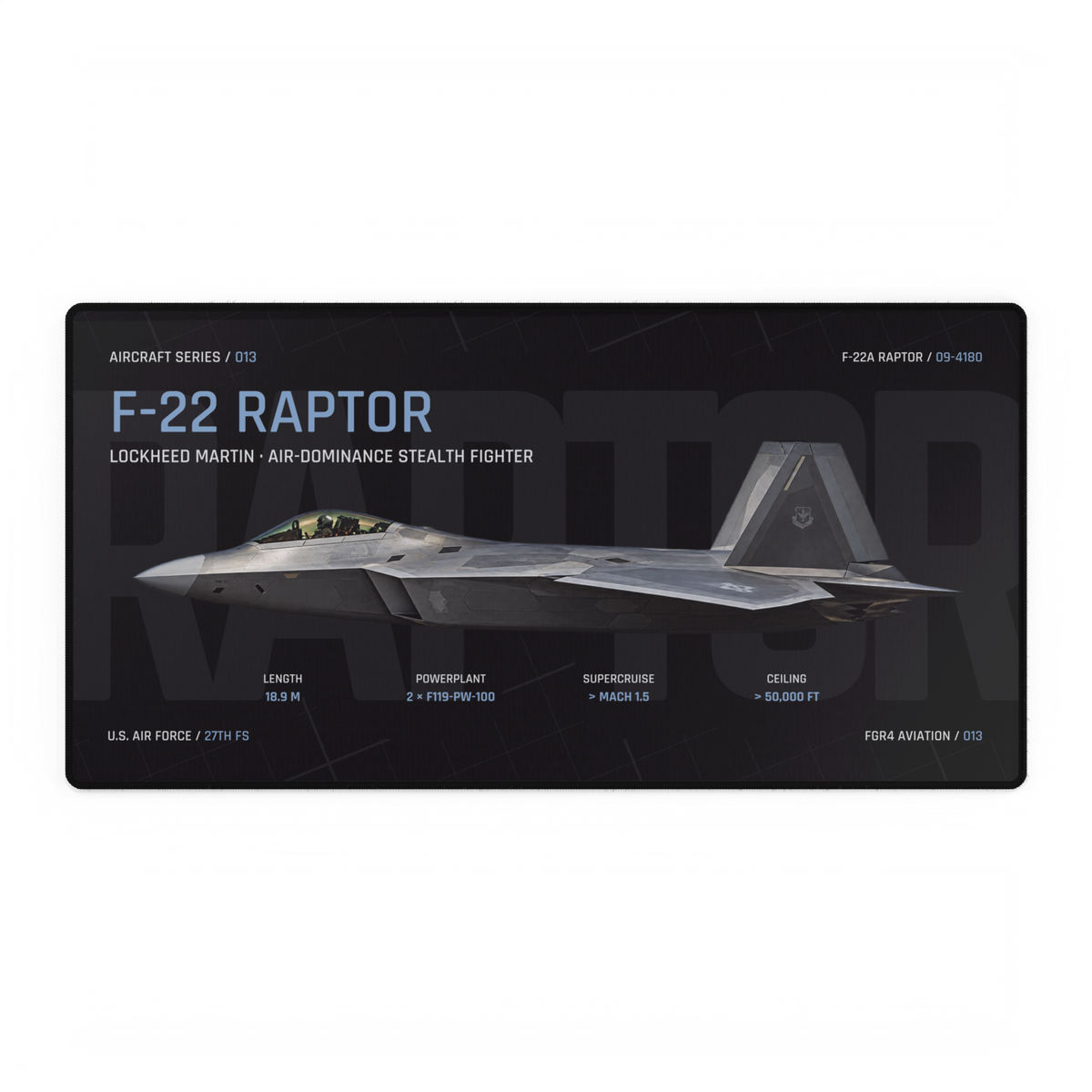
The F-22 Raptor and F-35B Lightning II share several features that can mislead a quick silhouette check: both are single-seat stealth fighters with sharply swept edges and two outward-canted vertical tails. The fastest reliable method is to start at the rear, then use the viewing angle to decide which other clues are actually visible.
One limit matters from the start. A clean silhouette can usually separate an F-22 from the wider F-35 family. It cannot always prove that the F-35 is the short-take-off and vertical-landing B variant, because several of the B model’s defining features are hidden when its doors are closed.
Start with the strongest clue: two exhausts or one
Lockheed Martin’s official F-22 page identifies its F119 engines, while the company’s product card provides an official top-view reference. The airframe’s rear resolves into two engine paths and two rectangular nozzle openings. Lockheed Martin’s F-35B history describes the F-35’s single engine and the swivelling jet pipe used during vertical flight.
That makes a rear or high rear-quarter view decisive: two separate exhaust nozzles point to the F-22; one central nozzle points to the F-35. Do this check before studying the nose or tail, because the exhaust count is a structural difference rather than a styling impression.
Do not use twin tails as the answer
Both aircraft have two canted vertical tails. “Twin tails” therefore confirms neither type. Instead, examine what sits between and beneath them. The F-22’s two-engine layout creates a broad rear body with a nozzle on each side. The F-35 narrows towards one central exhaust.
Viewing angle can hide this distinction. In a true side profile, the far exhaust and far vertical tail may overlap the near ones. If the rear is obscured, move to the next checks rather than forcing a conclusion.
Use the whole planform in a top view
From above, compare the full outline rather than one isolated feature. The F-22 presents a broad, blended shape through the wing roots and rear fuselage, with the two engine paths continuing towards separate nozzles. The F-35 has a more compact single-engine centreline and a different wing-to-tail relationship.
Official dimensions support the difference in overall scale: Lockheed Martin’s F-22 product card gives 18.9 metres in length and a 13.56-metre wingspan, while its F-35B product card gives 15.6 metres and 10.7 metres. Do not make size your first test, though. Posters, diagrams and product images are often rescaled to fit the same frame.
Treat the side view as a family check
Side profiles are excellent for comparing the nose, canopy, intake position, wing root and tail as one continuous shape. They are less useful for counting engines or proving an F-35 variant. On the F-22, look for the long, low forward profile flowing into a broad body and the angular two-dimensional nozzle area. On an F-35 profile, look for the deeper single-engine body and the compact relationship between canopy, intake and wing root.
These are comparison cues, not one-feature rules. Lighting, perspective and external stores can alter the outline. Our guide to side, top and front aircraft views explains why changing the view changes what you can identify.
Why “F-35B” sometimes needs a label
The B variant’s defining system is its short-take-off and vertical-landing arrangement. Lockheed Martin describes a shaft-driven LiftFan behind the cockpit and a swivelling rear jet pipe. In vertical-flight configuration, opened doors around the lift system and the rotated nozzle provide strong B-variant evidence.
In ordinary forward flight or a clean side-profile artwork, those doors may be closed and the nozzle aligned aft. At that point, the silhouette tells you “F-35” more confidently than it tells you “F-35B”. Confirm the variant from a trustworthy caption, serial, operator context or another view showing variant-specific detail.
The four-check recognition card
Count visible exhausts: two for the F-22, one for the F-35 family.
Compare the whole wing, body and tail outline. Do not rely on twin tails alone.
Use nose, canopy, intake, wing root and rear body together as a family-level check.
For “F-35B”, verify the caption, operator or visible STOVL configuration.
Apply the method to aviation artwork
The owned hero image shows the live F-22 Raptor Aircraft Desk Mat in its Night Edition product mockup. Its side profile is useful for studying the F-22’s continuous nose-to-tail outline, but the view does not expose both exhausts clearly. That is exactly why the recognition card uses several checks.
Compare it with the live F-35B Lightning II Aircraft Desk Mat. Both products were available in Night and Studio editions when checked for this guide. Open each product image at full size, ignore the labels for a moment, and compare the nose, intake, wing-root and rear-body shapes before revealing the answer.
For another two-aircraft exercise, try our 747 and A380 silhouette guide. You can also browse the live Aircraft Series and apply the same rule across the range: begin with a structural difference, then use smaller shape cues to confirm it.
Sources and product availability checked 3 October 2026. Hero image: owned FGR4 F-22 Raptor Night Edition product mockup. Recognition guidance is for visual identification from public imagery and artwork; angle, configuration and image quality can hide features.