
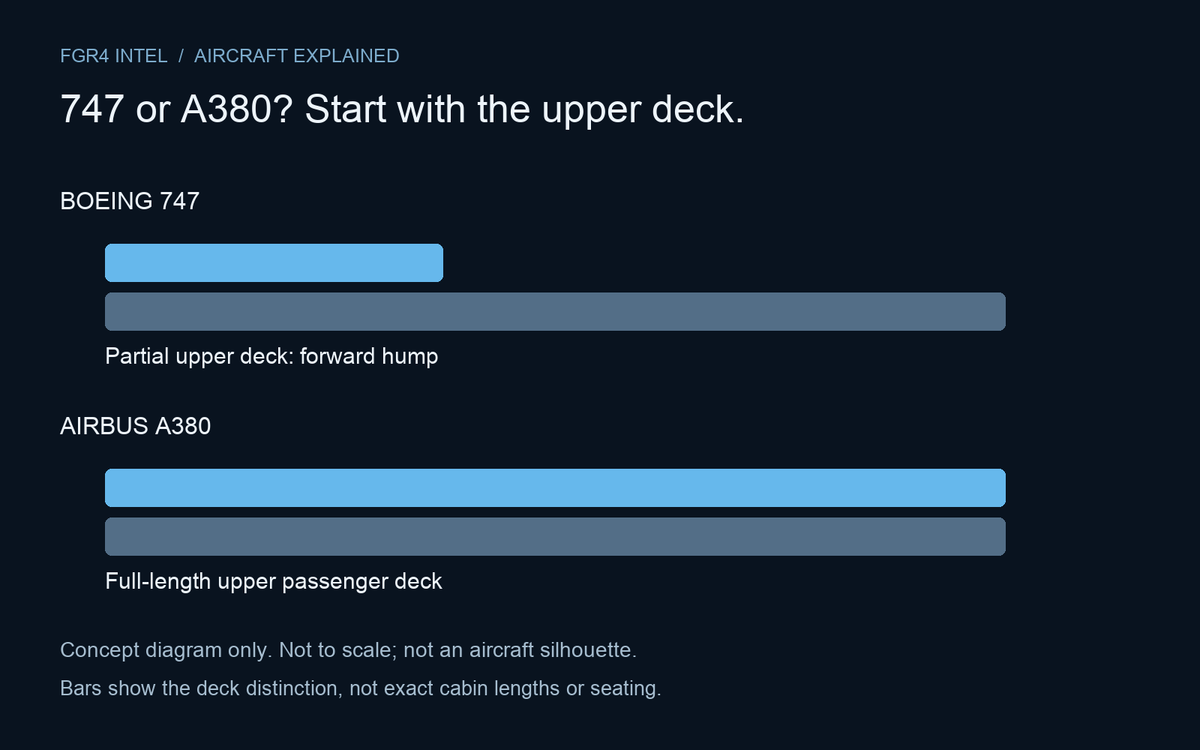
Look at the upper deck first. The Boeing 747 has a raised forward section that gives it its familiar hump. The Airbus A380 carries its double-deck passenger layout along the cabin, giving the body a different overall shape.
That is a useful starting point when comparing an airport photograph, a model or a piece of aircraft artwork. You do not need to begin with dimensions or try to judge which aircraft looks larger in the picture.
Read the roofline
Boeing's 747 overview highlights the aircraft's distinctive hump. In a clear side view, follow the top of the forward fuselage backwards: the raised section transitions into the lower roofline behind it. That change in height is the feature to look for.
Airbus describes the A380 as a full-length double-deck jet airliner. Its upper passenger deck is not confined to a short forward section. In a useful side photograph, look for the two levels of cabin windows extending along the passenger cabin.
What the diagram shows
Our diagram reduces the comparison to two sets of bars. The blue bar represents the upper deck and the grey bar the main deck. It is an original explanatory graphic, not a scale drawing, cabin plan or aircraft silhouette. Equal main-deck bars do not mean the aircraft have equal dimensions.
Use it to remember the question: does the upper level occupy a forward section, or continue along the passenger cabin? Then return to a real photograph and look for the corresponding roofline and window pattern.
Use more than one visual clue
Start with a photograph where you can see the side of the body clearly. A view from nearly head-on compresses the length; a close crop may remove the very section you need to compare. If the image leaves the upper deck unclear, choose another view instead of forcing an identification.
- Trace the roofline from the nose towards the tail.
- Look for the extent of the upper cabin, using the window rows where visible.
- Check the image caption or aircraft record to confirm your interpretation.
- Only then move on to identifying a specific variant.
The 747 is a family, not one fixed outline. Boeing's overview includes several generations and both passenger and freight aircraft. This short guide is a broad comparison of the conventional passenger 747 shape with the A380-800; it is not a variant-identification key. Do not use the length of our blue bar to distinguish one 747 version from another.
Try it with two photographs
Open a clear side view of each aircraft in the manufacturers' linked pages. Before reading the caption, describe the upper portion of the body in a sentence. Check your description against the caption, then repeat with a different angle.
The exercise is useful because it makes you name the feature you actually see. “It looks huge” depends on the surroundings and camera position; describing the roofline gives you something specific to check.
Look for the same features in aviation artwork
A recognisable aircraft design depends on which features remain legible when the image is simplified or seen at a distance. Our article on side-profile aircraft artwork explores that design question. For a practical example of visibility on a working surface, see what a keyboard covers in Typhoon artwork.
For the next aircraft read, continue with our A380-800 design explainer. You can find more aircraft and airfield articles in FGR4 Intel.