
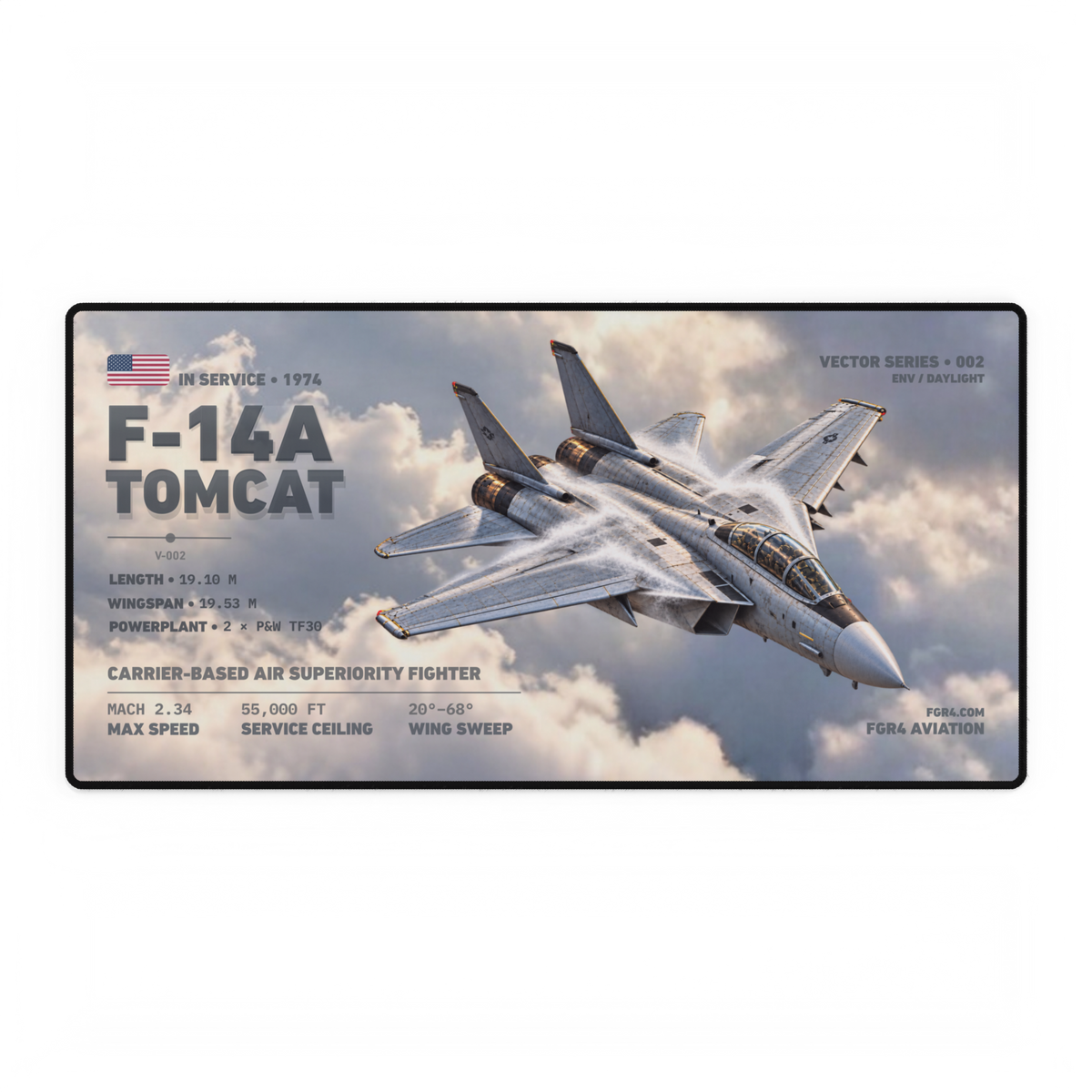
The F-14 could sweep its wings so one carrier fighter could use a broader, straighter-looking planform in comparatively slow flight and a more sharply swept planform at higher speeds. Moving the outer wing panels changed the balance between low-speed lift and handling, drag, and high-speed efficiency. It also changed the Tomcat’s outline so dramatically that the same aircraft can look like two different types in photographs.
The live F-14A Vector design uses a swept-wing three-quarter view, while the Aircraft Series uses a technical side-profile composition.
Why a fixed wing would force a compromise
A wing that works well during take-off, approach and landing does not have exactly the same priorities as one intended for faster flight. NASA’s account of variable-sweep research explains the broad trade-off: a straighter wing can provide useful lift and handling qualities during comparatively slow flight, while a swept-back wing can reduce drag and improve efficiency at high and cruise speeds.
A fixed wing has to settle on one geometry. A variable-sweep design adds pivots and a strong internal mechanism so the wing can change angle in flight. That flexibility comes with a cost. NASA also notes that the pivoting mechanism must be robust and therefore carries a substantial weight penalty. The Tomcat’s moving wing was an engineering choice, not a free aerodynamic trick.
What actually changes on the F-14?
The F-14 does not fold the whole wing or change the fuselage. Its outer wing panels pivot around points in the fixed centre section. As the panels move aft, the span becomes visually narrower and the leading edges form a sharper arrow. With the panels forward, more of the wing projects out from the fuselage and the planform looks broader.
That means “wings forward” and “wings swept” are useful visual shorthand, but they are not two separate aircraft modes. The wing could occupy positions between those extremes. NASA later selected an F-14 for the Variable-Sweep Transition Flight Experiment partly because its sweep capability let researchers study different flight conditions and sweep angles.
ILLUSTRATIVE PLANFORM CHECK · NOT TO SCALE
Broadest visible span; outer panels project clearly from the centre section.
The outline transitions rather than jumping between two fixed shapes.
Compact span and a more pronounced arrow-shaped planform.
How the changing wing alters identification
Wing sweep is the quickest clue when you compare two Tomcat images from above, but it is also the clue most likely to change. A reliable identification does not stop at the wing outline. Check the fixed structure around it:
- Twin vertical tails: two fins rise above the rear fuselage, spaced apart rather than mounted as one central tail.
- Separated engine nacelles: the two engine bodies create a broad channel through the rear underside and a wide-set tail arrangement.
- Long nose and tandem cockpit: the forward fuselage remains recognisable as the wings move.
- Fixed centre section: the wing gloves at the fuselage shoulders stay in place while the outer panels pivot.
This fixed-clue method matters because camera angle can hide one tail, compress the nacelle spacing or make a partially swept wing look more extreme. The same discipline helps with modern stealth fighters: our F-22 versus F-35B silhouette guide uses several independent clues instead of trusting a single outline feature.
Read the planform in three steps
- Find the pivots. Trace the leading edges out from the fixed wing gloves and notice where the outer panels begin to change direction.
- Estimate the visible span. A broad lateral reach suggests a forward position; a tight arrow suggests a more swept position.
- Confirm the aircraft. Use the twin tails, engine spacing and forward fuselage before calling the silhouette an F-14.
Do this before trying to infer exactly what the aircraft was doing. A photograph records one instant and may not show speed, control-system state or pilot intent. The safe conclusion is visual: the image shows a particular wing position, and that position changes the planform.
Why the Tomcat is useful for aircraft artwork
Most aircraft keep roughly the same planform from one image to the next. The F-14 makes view selection unusually important because the artist is also choosing a wing position. A swept three-quarter view emphasises the compact arrow shape and the space between the nacelles. A forward-wing view emphasises span and makes the pivoting outer panels easier to compare with the fixed centre section.
For a structured side view, open the F-14 Tomcat Aircraft Desk Mat or browse the Aircraft Series. For larger atmospheric three-quarter compositions, compare the Vector Series. The guide to aircraft general-arrangement drawings explains how plan, side and front views divide up the identification job.
The short answer
The F-14 swept its wings because no single fixed angle was ideal across all of the conditions the aircraft had to cover. Forward positions supported the qualities needed in comparatively slow flight; greater sweep suited faster flight by reducing drag and improving efficiency. The price was a heavy, complex pivoting structure. For identification, the result is the Tomcat’s defining visual trick: one airframe, a planform that can move, and several fixed clues that remain when the outline changes.
Sources
Sources, live products and collections checked 18 October 2026. The three-position card is an illustrative reading aid and is not a scale drawing. FGR4 Aviation is not presented as affiliated with or endorsed by NASA or any aircraft manufacturer or operator.