
When an airport renumbers a runway, the strip of pavement does not rotate. The identifier changes because the runway’s magnetic direction has crossed into a different ten-degree band. That small change on the threshold then has to travel through the rest of the airport system: signs, charts, approach names, operational notices and pilot briefings all need to agree.
That makes renumbering a useful reminder that a runway number is live navigational information, not a permanent name. Here is the change map, followed by two official examples.
First, the number follows magnetic direction
The FAA Aeronautical Information Manual says runway numbers indicate the nearest ten-degree increment of the runway centreline’s magnetic azimuth. A magnetic direction of 183 degrees is therefore designated 18, while 87 degrees becomes 9. If the value ends in 5, the FAA allows either adjacent designation.
The concrete does not need to move for that magnetic value to change. FAA airport-planning guidance says periodic changes in magnetic declination can make runway renumbering necessary. Once a value crosses the relevant rounding boundary, the old painted number no longer matches the designation that the current magnetic direction calls for.
If you want the basic numbering convention first, the FGR4 guide to airport runway numbers, reciprocal ends and L/R/C sets out that foundation. This article starts at the point where the identifier itself must change.
The runway-renumbering change map
Threshold numbers and related airfield markings are repainted for the new designation.
Runway-direction and holding-position signs must point pilots to the new identifier.
Airport diagrams, charts, databases, approach titles and other published references are revised.
NOTAMs, ATIS and local notices help crews recognise the change during the transition.
The four layers are an editorial way to read the change, not a substitute for an aerodrome’s official implementation plan. The important point is coordination: every operational reference needs to describe the same runway.
What normally stays the same?
A renumbering caused by magnetic variation is a change of designation. It does not, by itself, alter the runway’s physical alignment, length, threshold position or the route it draws across the ground.
An official UK example makes that distinction unusually clear. A Civil Aviation Authority-hosted consultation for Carlisle Airport described Runway 25 becoming 24, and the reciprocal Runway 07 becoming 06, because of magnetic variation. It called the change one of nomenclature and said it did not affect the routes aircraft flew over the ground.
That boundary matters when reading an old photograph or airport diagram. Different numbers do not automatically prove that a runway was rebuilt. Compare dates and official charts before treating the label change as a change in geometry. The FGR4 guide to recognising an airport layout from its runway skeleton helps separate the large physical pattern from its smaller labels.
What does the airport have to update?
The visible job starts with the large numerals painted near each threshold. Associated signs also need to use the new designator, including the red-and-white runway holding-position signs that tell a pilot which runway lies ahead. The runway-versus-taxiway reading guide explains why labels and the drawing key should be checked before shape or colour alone.
The information job is wider. Airport diagrams, instrument procedures and references used in flight planning have to match the new identifier. The FAA’s current Tucson airport briefing provides a practical example: it says runway numbers were updated to reflect current magnetic declination, signs and markings changed, approaches would be updated, and pilots should check NOTAMs and listen to ATIS for current information.
That does not mean every renumbering follows one identical timetable. Airports and authorities coordinate the affected material for their own operation. The reliable reader response is to treat an old designator as time-sensitive and use current official aeronautical information for real navigation.
Use the reciprocal-end check
Because the two approach directions face opposite ways, paired runway numbers are normally 18 apart. If one end changes from 25 to 24, the other moves from 07 to 06. That reciprocal check is a useful way to spot whether a diagram’s two ends belong to the same strip.
Parallel letters reverse with the viewing direction. A left runway seen from one approach becomes the right runway when seen from the opposite end. Large or unusually separated parallel systems can involve additional designation rules, so current airport information remains the authority.
Read the Heathrow artwork as a fixed-date snapshot
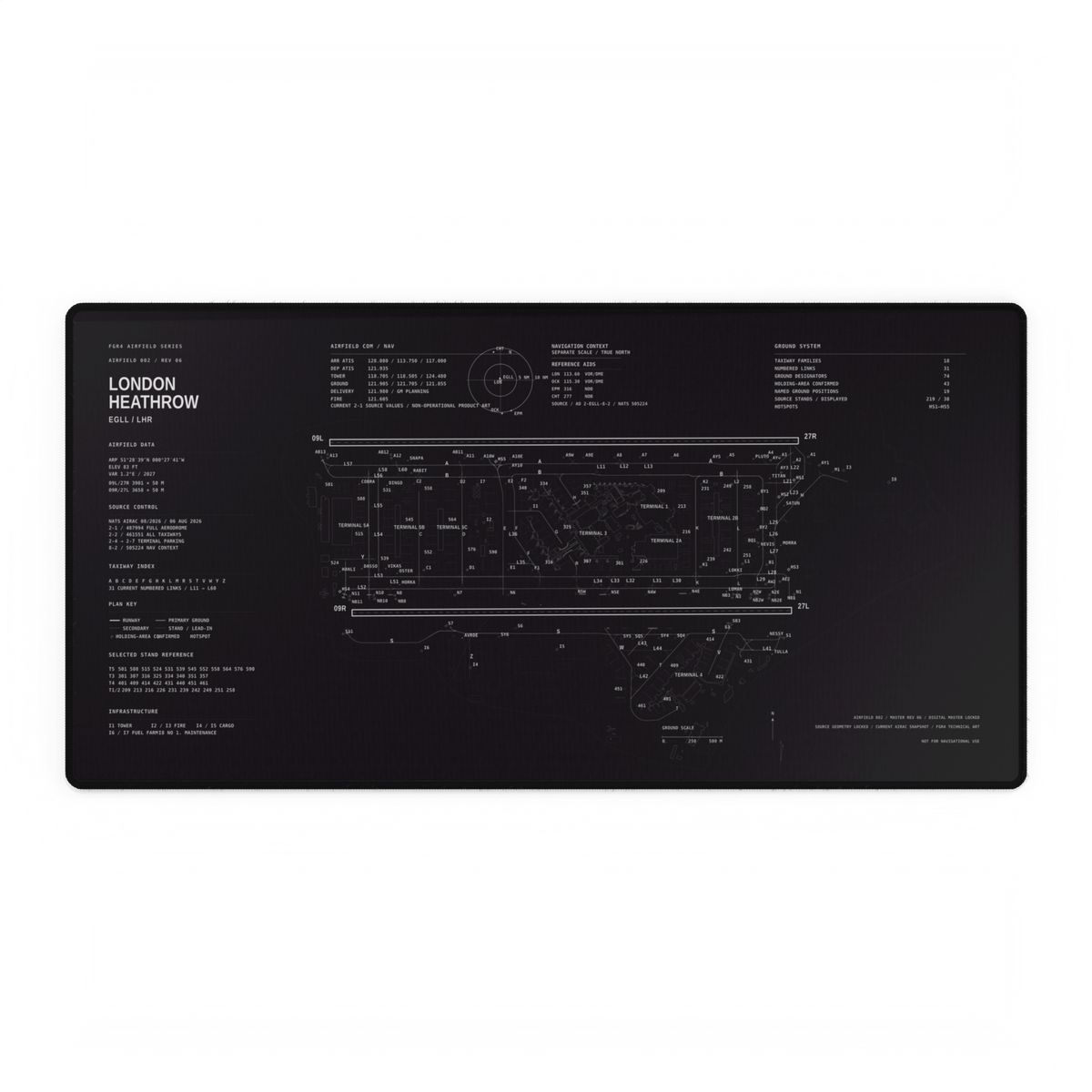
The owned hero above shows the live London Heathrow Airfield Desk Mat. Its two long parallel runway bars are labelled 09L/27R and 09R/27L, making the reciprocal relationship visible at a glance. The product’s single 800 × 400 mm variant was available when checked for this article.
The artwork is a designed product image, not a current aeronautical chart and not evidence that Heathrow is being renumbered. It is useful here because it lets you separate the physical runway skeleton from the labels attached to it. If those identifiers changed in a future official update, the broad two-runway geometry could still look familiar.
Browse the live Airfield Series to compare six airport layouts, or read why runway geometry suits a wide desk-mat format. For real-world flying or surface movement, always use current official charts, notices and instructions.
Sources and product availability checked 11 October 2026. Technical basis: current FAA Aeronautical Information Manual runway-designator guidance; FAA airport-planning guidance on magnetic declination; FAA Tucson operational briefing; and the CAA-hosted Carlisle consultation example. Hero image: owned FGR4 London Heathrow Airfield Desk Mat artwork, inspected at full resolution. Product artwork is not for navigational use.