
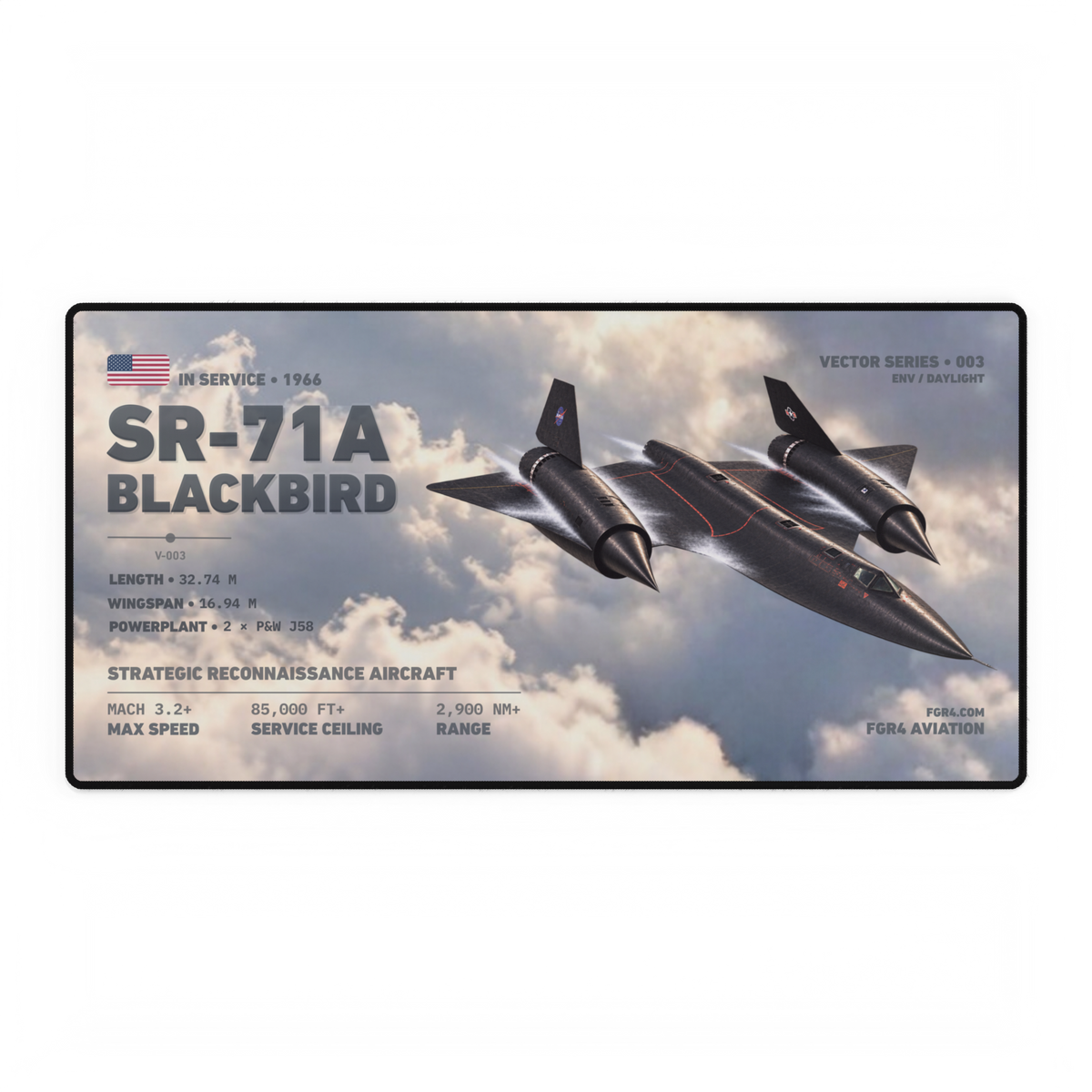
The SR-71’s chines are the long, sharp-edged fairings that run from its pointed forebody towards the wing. They make the nose look wider and flatter than a simple cylindrical fuselage, then blend that forebody into the Blackbird’s delta planform. The shape added lift and influenced trim and stability, so it was part of the aircraft’s aerodynamics as well as one of its strongest identification clues.
The live SR-71A Vector design uses a three-quarter view where the pointed forebody, broad chine line and delta wing can be read together.
Where is the chine on an SR-71?
Start at the tip of the nose and follow the hard outer edge rearwards on either side of the cockpit and fuselage. That edge is not the leading edge of a separate little wing. It belongs to a tapered side fairing attached around the circular centre-body structure. NASA’s Blackbird design history describes the feature as a pronounced “blended forward wing-body” extending from the nose to the wing’s leading edge.
From above, the two edges turn the front of the aircraft into a broad spearhead. From a side view, the chine is subtler because the wide horizontal surface is foreshortened. This is why a three-quarter or plan view explains the Blackbird’s shape more clearly than a pure profile.
TRACE THE EDGE · ILLUSTRATIVE, NOT TO SCALE
Begin at the narrow nose, before the forebody broadens beside the cockpit.
Trace the sharp boundary running rearwards along each side of the forward fuselage.
The edge continues into the wing, making the forebody and delta planform read as one shape.
The chines did real aerodynamic work
The chine was more than a styling line. NASA’s design paper says the Blackbird’s fuselage side fairings generated nearly one fifth of the aircraft’s total lift. Acting rather like fixed canards, they helped with trim drag and reduced the rearward movement of the aerodynamic centre of pressure as speed increased from subsonic to supersonic flight.
The same source also records the trade-off. Because the chine lift acted ahead of the centre of gravity, it reduced pitch stability. The designers accepted relatively low stability margins to avoid the drag that larger control deflections would have produced, then used an automatic flight-control system to compensate. The useful lesson is that one feature can add lift and support efficient trim while also creating a control problem that the rest of the aircraft must solve.
Why not call them small wings?
“Small wings beside the nose” is a tempting description, but it hides the feature that matters most. A conventional canard is a recognisable control or lifting surface set ahead of the main wing. The SR-71’s chine is a continuous fairing that grows out of the forebody and blends into the wing-body shape. NASA uses the canard comparison to explain its aerodynamic effect, not to describe a separate movable surface.
That distinction is useful when reading photographs and artwork. Look for continuity. If the edge begins at the forebody and remains part of the fuselage-to-wing blend, you are looking at the chine. Do not expect a hinge line, an isolated surface or a gap around it.
Four fixed clues confirm the Blackbird
The chine may be the first clue you notice, but camera angle, shadow and black paint can make a single edge difficult to read. Confirm the aircraft with features that stay in the same place:
- Long pointed forebody: the nose extends well ahead of the cockpit and broadens along the chine edges.
- Thin delta wing: the wing and forebody form a continuous planform rather than a clearly separate fuselage and wing.
- Widely spaced engine nacelles: the two large nacelles sit within the wing planform, away from the centreline.
- Twin inward-canted fins: one vertical fin sits above each engine nacelle.
This several-clue method is the same discipline used in the F-22 versus F-35B silhouette guide. It also connects directly to yesterday’s F-14 variable-sweep planform guide: one aircraft changes its outline through moving wings, while the Blackbird’s forebody-to-wing blend remains fixed.
Choose the view by the question
A technical side profile is useful for reading the length of the nose, cockpit position, nacelles and vertical fins. Open the SR-71 Blackbird Aircraft Desk Mat or browse the Aircraft Series for that structured approach.
A three-quarter view does a different job. It reveals how the chines widen the forebody and flow into the delta wing, which is why the chine is easier to understand in the Vector Series composition. Neither view tells the whole story alone: profile explains the aircraft’s length and arrangement; plan or three-quarter view explains the blended shape.
The short answer
The SR-71 had chines because its forebody was designed as part of the lifting, blended wing-body rather than as a simple tube ahead of the wing. Those tapered side fairings added lift, influenced trim and aerodynamic-centre movement, and created stability effects that the flight-control system had to manage. Visually, they create the hard nose-to-wing edge that makes the Blackbird identifiable before you read its name.
Sources
- NASA NTRS: Design and Development of the Blackbird — Challenges and Lessons Learned
- NASA: NASA’s Contributions to Aeronautics, Volume 1
Sources, live products and collections checked 19 October 2026. The trace-the-edge card is an illustrative reading aid and is not a scale drawing. FGR4 Aviation is not presented as affiliated with or endorsed by NASA, any aircraft manufacturer or any operator.