
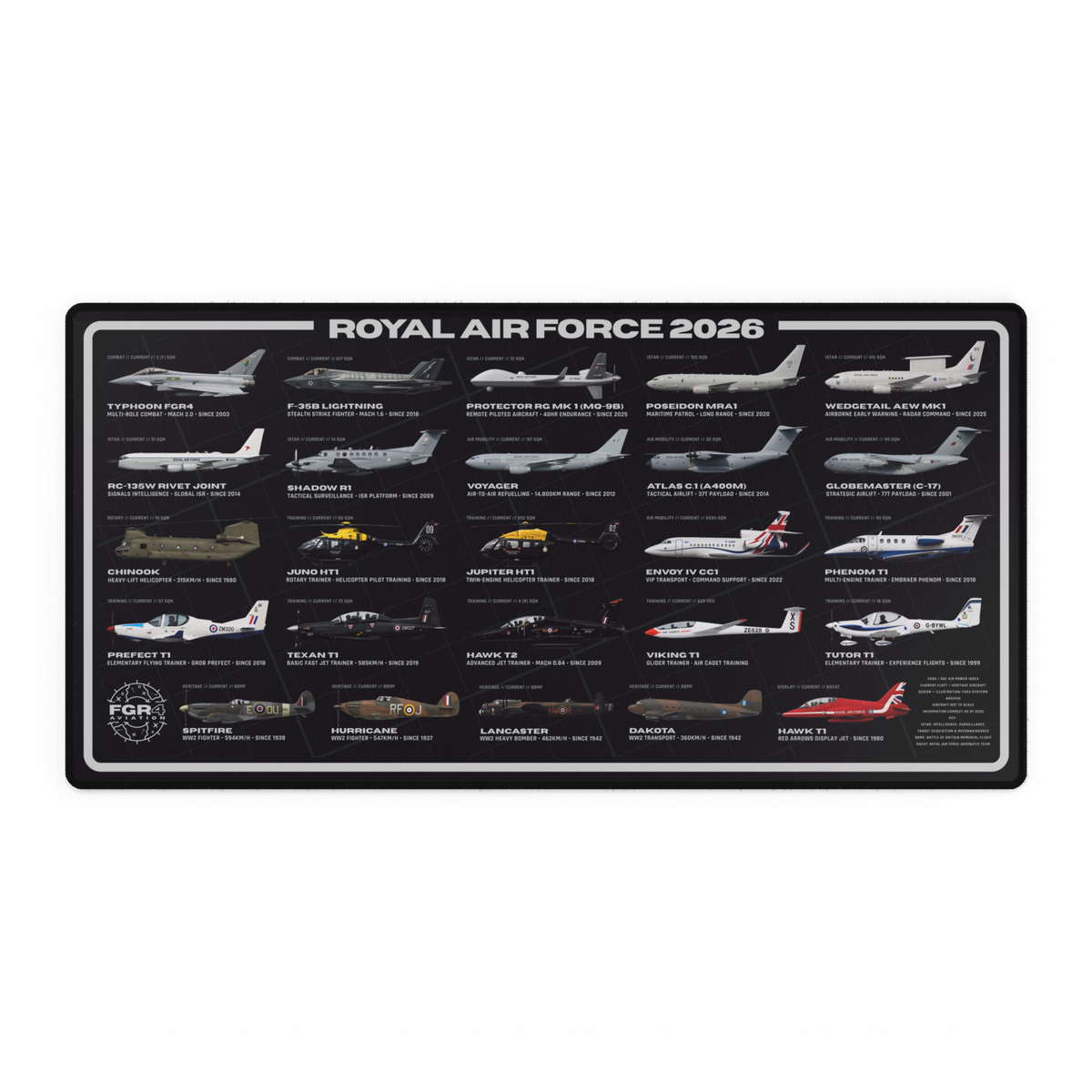
To read an RAF aircraft fleet list accurately, start with the date and definition before you read the aircraft names or totals. A current RAF aircraft page, an annual Ministry of Defence statistics table and an illustrated fleet line-up can all be useful, but they answer different questions.
The quickest method is to check five things in order: the source, snapshot date, service or operator, aircraft type or mark, and the note attached to the count. That stops a historical list, a capability page or a statistical total from being mistaken for a live readiness report.
Read an RAF fleet list from left to right in this order. The number only becomes meaningful after the date and definition are clear.
1. Identify what kind of fleet list you have
The RAF’s aircraft directory presents active aircraft and explains where and how they are used. It is a capability-led guide: entries are grouped around roles such as combat, transport, training and ISTAR.
The MOD’s UK armed forces equipment and formations publication is different. It is an annual statistical snapshot covering aircraft across the armed forces. The 2026 edition was published on 20 August 2026, but its headline equipment date is 1 April 2026. A publication date and a fleet snapshot date are not interchangeable.
An illustrated FGR4 line-up has another purpose. It helps readers compare aircraft visually and see a collection as a composition. It should be read as artwork, not as an official readiness table.
2. Read the aircraft name, mark and role separately
An aircraft family name tells you less than a full designation. “Typhoon” identifies the family; “Typhoon FGR4” identifies the RAF mark and includes a role abbreviation. “Voyager KC2/KC3” combines a family name with tanker and transport designations.
Keep three fields separate:
- Type or family: the broad aircraft identity, such as Typhoon, Atlas or Voyager.
- Mark or variant: the specific service designation, such as FGR4, C1 or KC2/KC3.
- Role: what the aircraft is used to do, such as combat, transport, training, air refuelling or ISTAR.
The RAF role-abbreviation glossary decodes FGR, C, KC and AEW. For concrete role examples, the Typhoon, Atlas and Voyager role guide shows why one label does not describe the whole fleet.
3. Check who owns or operates the aircraft
A UK military aircraft table can include more than the RAF. The MOD publication covers the armed forces and may organise equipment by service or command. Joint forces and contract-operated platforms also need careful reading.
Do not assign every aircraft in a UK total to the RAF. Look for the service, command or operator column, then read any footnote explaining joint ownership, contracted provision or unavailable status data.
4. Treat every count as a defined snapshot
A total platform count, an “in service” count and the number available for a task are different measures. The annual MOD table can establish what was recorded under its definitions on the snapshot date. It does not by itself establish how many aircraft are serviceable, crewed, deployed or ready to launch when you read the article.
The dedicated guide to what “in service” means on an RAF fleet list explains why the table note matters and why fixed-wing and rotary-wing definitions need to be read separately.
5. Use the notes before comparing years
A change between two annual lists can reflect deliveries, retirements, transfers or disposals. It can also reflect revised data, a new category or a changed method. The MOD’s collection page keeps earlier editions, while its background quality report explains provenance, quality and comparability.
Before describing a rise or fall:
- compare the same snapshot date across editions;
- confirm that the aircraft category is defined the same way;
- check whether a figure was revised;
- separate a fleet total from an in-service subset; and
- avoid turning a statistical change into an operational claim without another source.
How FGR4 uses a fleet list
For visual reference, a fleet list helps organise aircraft families and marks. The Royal Air Force 2026 Fleet Desk Mat turns that subject into an FGR4 composition; it is not presented as an MOD statistical product. The broader Fleet Series collects the current line-up artwork.
The original RAF 2026 Fleet Poster Brief explains the design approach behind the line-up. Use official RAF and MOD pages for current capability and statistical claims.
The short answer
Read an RAF fleet list in this order: source, snapshot date, operator, aircraft designation, role, count and footnote. The sequence matters because the same aircraft can appear in a capability directory, an annual statistics table and an illustrated line-up for different reasons. A number becomes useful only when its date and definition are attached.
Sources
- Ministry of Defence: UK armed forces equipment and formations 2026
- Ministry of Defence: equipment and formations publication collection
- Royal Air Force: current aircraft directory
Prepared from official RAF and MOD sources checked 27 October 2026. FGR4 Aviation is an independent aviation artwork brand and is not affiliated with or endorsed by the Ministry of Defence or the Royal Air Force.