
On an RAF aircraft fleet list, “in service” is a statistical category defined for that table. It does not automatically mean every counted aircraft is serviceable, mission-ready, crewed, deployed or available to fly today.
The Ministry of Defence’s 2026 equipment statistics make the distinction explicit. For fixed-wing aircraft, “in service” means aircraft in active fleet management, and the category can include aircraft in storage. The same publication uses a different definition for rotary-wing aircraft: those in the effective forward fleet, with a slightly different treatment for Navy Command aircraft.
A fleet total, an “in service” count and an aircraft available for a particular task answer three different questions. The table note tells you which one you are looking at.
Use a three-part reading key
Fleet figures become easier to interpret when you separate three layers.
THE FLEET-LIST READING KEY
The aircraft is included in the publication’s total for that equipment category.
The aircraft meets the specific definition printed for that table and service.
A separate operational question that the annual equipment snapshot does not answer.
This prevents a common mistake: treating a published fleet number as a live readiness board. Annual equipment statistics describe the size and status of the recorded fleet at a set date. They do not report how many aircraft could launch for a mission at the moment you read the page.
What the 2026 fixed-wing figures say
The MOD recorded 507 fixed-wing platforms across the UK armed forces at 1 April 2026. “In service” figures were available for 374 of them, and 323 of those 374 were classed as in service. The publication reports that as 86%.
The denominator matters. It is not 323 out of all 507 fixed-wing platforms. The report says “in service” figures are unavailable for platforms operated under contracts, so the percentage covers only aircraft for which that status is recorded.
For fixed-wing aircraft, the MOD defines the in-service group as aircraft in active fleet management. It adds that this can include aircraft in storage. A stored aircraft can therefore sit inside the statistical category without being ready for immediate use.
Why rotary-wing figures need their own note
The same publication recorded 249 rotary-wing platforms at 1 April 2026. Of the 213 aircraft with an in-service figure, 165 were classed as in service, or 77%.
Here the note changes. “In service” refers to aircraft in the effective forward fleet, and the MOD says the definition differs slightly for aircraft owned by Navy Command. That is why an in-service percentage should not be compared across fixed-wing and rotary-wing tables as if the labels were identical.
The glossary reinforces the point: the meaning varies between equipment types and services, and readers should use the notes attached to the relevant table.
What “in service” does not prove
An in-service count is useful, but it has limits. By itself it does not establish:
- how many aircraft were serviceable on a later date;
- how many were assigned to operations, training or maintenance;
- how many crews were available;
- how quickly a stored aircraft could return to use;
- how many contract-operated platforms were available; or
- the readiness of a particular RAF squadron.
Those questions require different evidence, often with a more recent date and a narrower operational definition. Do not add a readiness claim to an annual fleet table unless the source actually reports readiness.
Four checks before quoting an RAF fleet number
- Check the snapshot date. The 2026 publication describes the fleet at 1 April 2026, even though it was published on 20 August.
- Read the table definition. Fixed-wing and rotary-wing aircraft do not use exactly the same in-service rule.
- Check the exclusions. Contract-operated platforms can appear in total platform figures without a recorded in-service status.
- Check for revisions. The MOD marks corrected figures and explains material changes under its revisions policy.
These checks also help when reading older editions. A change in number may reflect deliveries, retirements or disposals, but it can also reflect a revised method or definition. Compare the notes as well as the totals.
How to read an illustrated RAF fleet line-up
An illustrated fleet line-up and an official statistical table have different jobs. Artwork can help you compare silhouettes, relative visual character and the range of aircraft represented. A statistical publication explains what was counted, on which date and under which definition.
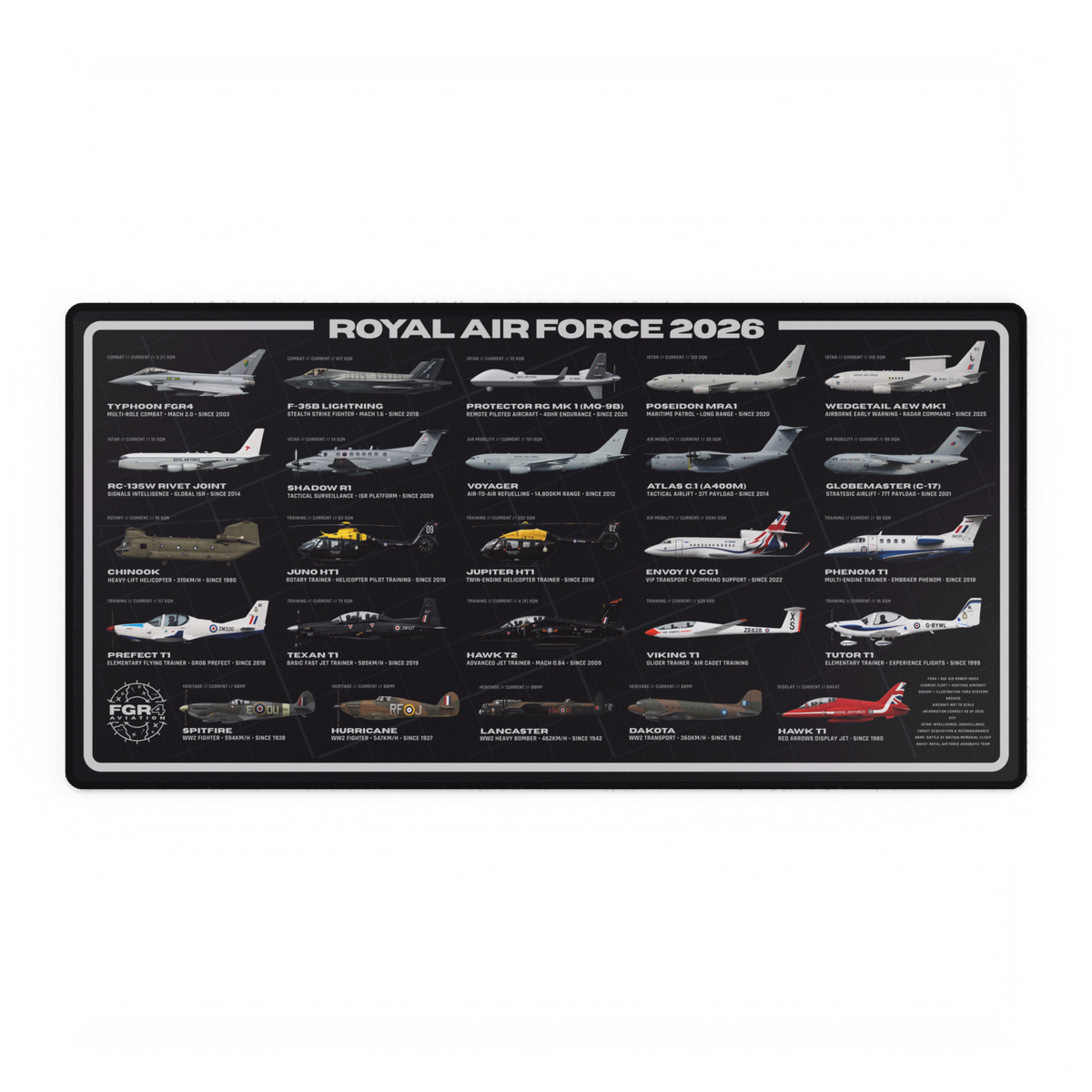
The Royal Air Force 2026 Fleet Desk Mat is an FGR4 visual composition. It should not be read as a statement that every illustrated aircraft meets the MOD’s statistical definition of in service. For the wider range, browse the Fleet Series.
For a role-based way into the line-up, read RAF aircraft roles: Typhoon, Atlas and Voyager explained. The original RAF 2026 Fleet Poster Brief explains the design thinking behind the fleet composition.
The short answer
“In service” means the aircraft fits the definition used in the relevant MOD table. For 2026 fixed-wing statistics, that means active fleet management and can include storage. For rotary-wing aircraft, it refers to the effective forward fleet, subject to a service-specific variation. It is a useful fleet-status measure, but it is not a live measure of readiness or availability.
Sources
- Ministry of Defence: UK armed forces equipment and formations 2026
- Ministry of Defence: background quality report for the 2026 equipment statistics
FGR4 Aviation is an independent aviation artwork brand and is not affiliated with or endorsed by the Ministry of Defence or the Royal Air Force.