
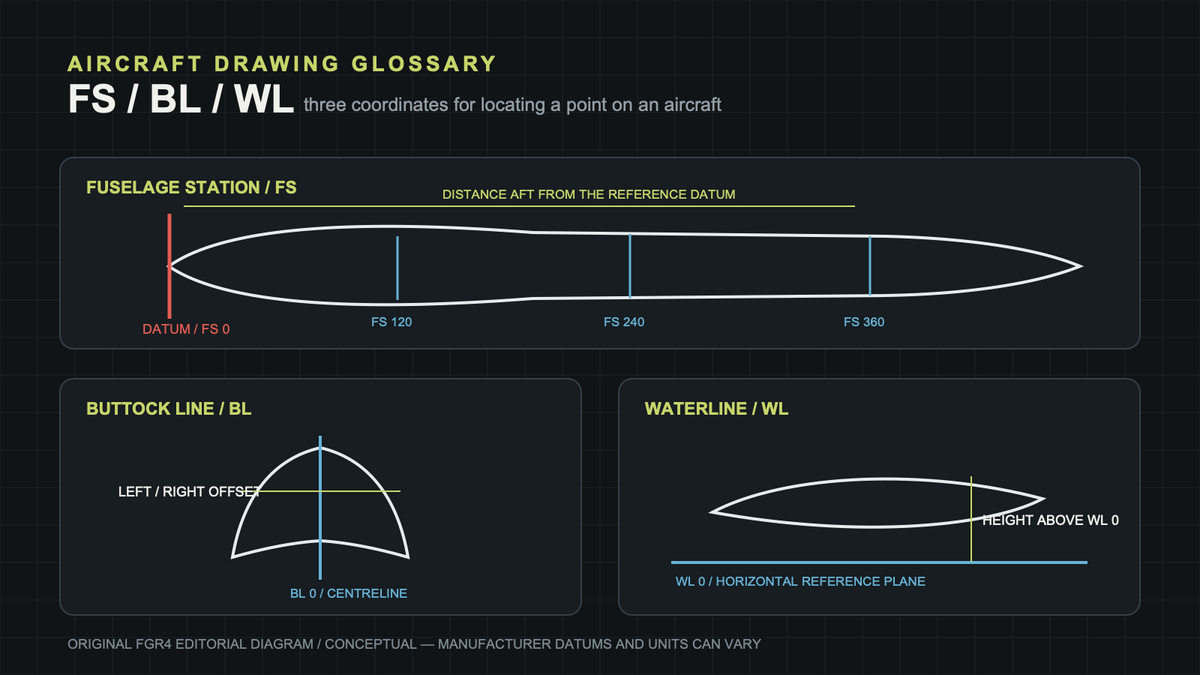
FS, BL and WL are aircraft location references. Together they describe how far aft, left or right, and above or below a defined reference plane a point sits on the aircraft.
They are useful when a drawing needs to identify a panel, frame, sensor, attachment or other feature precisely. The abbreviations are compact, but they only make sense when you read the drawing’s datum, units and left/right convention first.
Treat the three references like a coordinate system. Never assume the zero points are identical between aircraft.
What does FS mean?
FS means fuselage station. It gives a longitudinal position measured from a reference datum. In the FAA’s example, station values increase aft of the datum, so FS 240 identifies a plane farther back along the fuselage than FS 120.
The datum is an imaginary reference plane chosen for the aircraft; it does not have to sit on a visible part. Some manufacturers use body station or BS for the same kind of fore-and-aft reference. Always use the legend and maintenance data for the specific aircraft.
What does BL mean?
BL means buttock line or butt line. It describes lateral distance from the aircraft’s vertical centreline. Drawings may use LBL for a point to the left and RBL for a point to the right.
BL 0 normally marks the centreline reference. A larger number places the point farther outboard, but the drawing still needs to tell you which side of the aircraft applies.
What does WL mean?
WL means waterline. It gives a vertical position measured from a horizontal reference plane. A point can sit above or below WL 0 depending on the aircraft’s chosen convention.
The word does not mean the aircraft is intended for water. It is a geometric reference that lets a drawing describe height consistently across frames, compartments and installed equipment.
How the three references work together
One coordinate rarely gives a complete location. FS can identify the fore-and-aft plane, BL the lateral offset and WL the height. Used together, they can define a point in three dimensions.
That is why a general drawing often combines multiple views. The guide to aircraft general arrangement drawings explains how side, plan and front views divide the same subject into readable projections.
Read the drawing before reading the number
- Find the datum and zero planes. Their locations can vary by aircraft and manufacturer.
- Confirm the units. Do not assume inches or millimetres from the abbreviation alone.
- Check left and right. BL values need a side convention.
- Read the drawing title and legend. FS can mean fuselage station in this context, while other component drawings may use similar abbreviations differently.
- Use the correct view. A side view best shows FS and WL; a front or plan view makes BL easier to understand.
Good labels also depend on hierarchy. The article on line weight in technical aviation artwork shows how outlines, structure and annotation can be separated without giving every line equal visual weight.
Where technical artwork differs
Editorial artwork can borrow the clarity of engineering references without becoming approved maintenance data. A decorative diagram may simplify structure, omit dimensions or place labels for composition. Operational work requires the controlled drawing and revision for that aircraft.
For display-led work built around precise aircraft geometry, browse the FGR4 Vector Series. The comparison between technical labels and aircraft-led art can also help you decide how much annotation suits a room or desk.
The short answer
FS locates a point fore or aft from a datum, BL locates it left or right of the centreline, and WL locates it vertically from a horizontal reference plane. Read all three with the aircraft-specific datum, units and drawing legend.
Sources
- Federal Aviation Administration: Aviation Maintenance Technician Handbook—General
- NASA: F-106B aircraft reference stations example
Sources checked 30 October 2026. The hero is an original FGR4 conceptual diagram; manufacturer datums, notation and units can vary.