
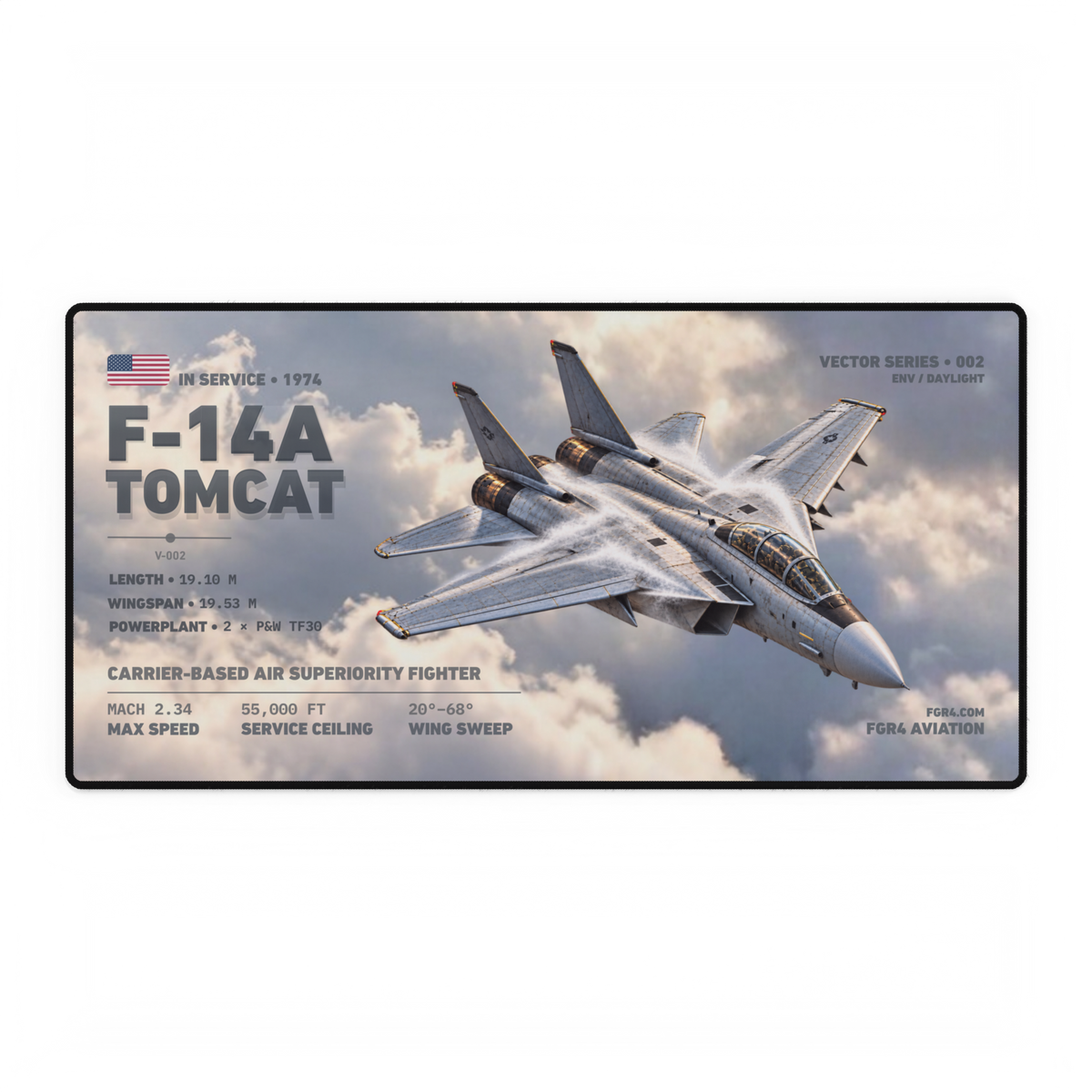
The quickest way to tell an F-14 from a Tornado is to ignore the moving wing for a moment. Check the tail and the rear fuselage first: the F-14 has two vertical fins and widely separated engine nacelles, while the Tornado has one vertical fin and a more compact, continuous rear-fuselage shape. Only then use wing sweep as a supporting clue.
That order matters because both aircraft can change their wing angle. A photograph with the wings forward can make either type look broad; a swept-wing view can make both look compact and arrow-shaped. The fixed structure around the wings is the reliable part of the identification.
The live Aircraft Series uses disciplined side-profile layouts for both subjects, making the fixed tail and fuselage clues easy to compare.
Start with the fixed clues
On the F-14, look for twin vertical fins rising from a broad rear section. From above or behind, the two engine nacelles sit apart with a visible channel between them. The cockpit and nose run forward from that wide centre section, giving the aircraft a broad-shouldered planform even when the outer wing panels are swept.
The Tornado presents a different set of anchors. It has one vertical fin, a narrower rear outline and a shoulder-mounted variable-sweep wing attached to a comparatively compact fuselage. These clues remain useful whether the wings are extended or swept and whether the photograph was taken from above, below or three-quarter front.
Then read the moving wing
NASA explains the broad logic of variable sweep: a less swept wing supports the lift and handling needed in comparatively slow flight, while greater sweep reduces drag and improves efficiency at higher speeds. The mechanism adds weight because the pivots and surrounding structure must be strong. Both the F-14 and Tornado used the same broad idea, but their fixed airframes remained visibly different.
The RAF Museum records a clear change in the Tornado GR1B's published span: 13.9 metres with the wings fully extended and 8.6 metres fully swept. That large change explains why wing position can dominate a silhouette. It also explains why a single outline match is weak evidence on its own.
On the F-14, the outer panels pivot beside large fixed wing-glove areas at the shoulders. The F-14 variable-sweep guide shows how those positions change the Tomcat from a broad planform into a tighter arrow. For identification, follow the moving leading edge back to the fixed centre section, then confirm the twin tails and separated nacelles.
A four-step F-14 versus Tornado check
- Count visible fins carefully. Two separated vertical fins strongly support F-14; one central fin supports Tornado. Allow for camera angle, which can hide the far F-14 fin.
- Trace the rear fuselage. Look for the F-14's separated nacelles and broad channel, or the Tornado's more continuous rear body.
- Find the wing pivots. Separate the fixed shoulder or glove area from the moving outer panel before judging the overall outline.
- Use another view if the stakes matter. A side profile, top view and rear three-quarter image together are much stronger evidence than one photograph.
What wing sweep cannot tell you
Wing position alone does not establish a precise variant, operator, date or mission. It does not prove the aircraft's speed or the reason for that setting at the instant a photograph was taken. A museum aircraft may also be displayed in a convenient position rather than an operational one.
This is the same discipline used in the F-22 versus F-35B silhouette guide: combine several independent clues and state only what the image supports. With swing-wing aircraft, the moving outline makes that habit even more important.
The short answer
Identify the F-14 by its twin fins, separated engine nacelles and broad fixed centre section. Identify the Tornado by its single fin and more compact continuous fuselage. After that, use the outer wing position to explain why the planform looks broad or sharply swept. The wing can move; the tail and core airframe give the type away.
To compare the two as structured side-profile artwork, browse the Aircraft Series.
Sources
- NASA: F-14 Tomcat
- NASA: AD-1 Oblique Wing
- NASA: X-5 Research Aircraft
- RAF Museum: The RAF in an Age of Uncertainty
- RAF Museum: Test pilots
Sources and product availability rechecked 25 October 2026. FGR4 Aviation is not presented as affiliated with or endorsed by NASA, the RAF Museum, the Royal Air Force, any operator or manufacturer.