
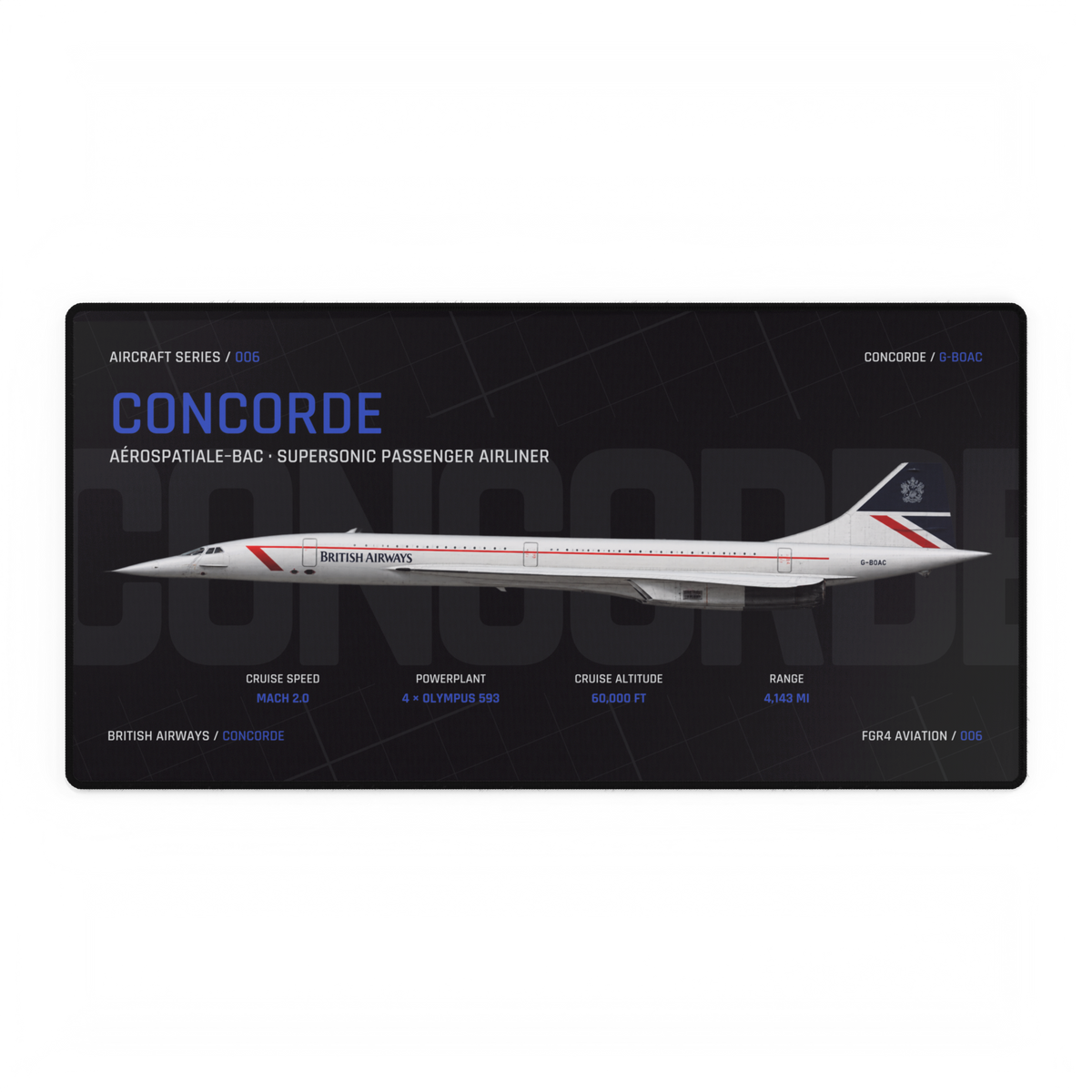
Start at the nose, follow the long fuselage, then look at the tail. In FGR4's Concorde artwork, those three features give the side profile its character before you read a single technical label.
This is a close look at the pictured Aircraft Series design, rather than a general history of Concorde. The numbered image below separates what the artwork shows clearly from the aircraft details that need a different view.
Three places to look

1. The pointed nose—and the feature a still image cannot demonstrate
The pictured nose forms a long taper ahead of the cockpit windows. Follow its lower edge back towards the body: the point is part of a continuous profile, not an isolated detail.
Concorde's real nose could move. Marshall, which designed and manufactured the drooping nose and retracting visor, explains that pilots lowered the nose during taxi, take-off and landing to improve visibility. It returned to a horizontal position for aerodynamic efficiency in flight.
That movement explains why photographs can show different nose positions. A single artwork presents one view; it does not show the mechanism operating. If you compare it with another image, check the nose position before deciding that the two outlines disagree.
2. The long fuselage carries the composition
In this product image, the aircraft runs almost the full width of the mat's design. The cabin windows and the coloured line along the body reinforce that horizontal direction. The large Concorde title sits above, leaving the aircraft itself as a separate visual element.
Try reading the image in two passes. First, ignore the lettering and follow the outer edge from nose to tail. Then look again at the windows, markings and labels. The first pass gives you the overall shape; the second adds the identity of the pictured aircraft.
This is an observation about the artwork, not a claim about the designer's intentions or a measurement of the real airframe.
3. The tail breaks the horizontal line
At the right-hand end, the fin rises above the fuselage and gives the otherwise long, low profile a clear vertical feature. Its sloping front edge is easy to follow against the dark background. Look at the outline first, then the painted markings within it.
The side view has limits. Concorde's wing shape is an important part of the aircraft, but the full planform is not laid out in this image. BAE Systems' Concorde history describes the slender-delta concept behind the programme. To study that shape, use an overhead or underside reference as well as a side profile; do not treat the visible edge here as a complete wing diagram.
What will stay visible on your desk?
Once you have found the details you like, consider where your keyboard and other equipment sit. Covering the middle of the design changes how much of the fuselage you see, while a notebook at one end can hide the nose or tail. Our keyboard-coverage guide demonstrates that placement question with explicitly illustrative layouts.
For the broader design idea, read why side-profile aircraft artwork works on a desk mat. The useful exercise is to compare the clear product image with the view you would actually have while working.
Explore the current Concorde Aircraft Desk Mat to check the available edition and dimensions. If a different aircraft is your subject, browse the Aircraft Series and look for the features you want to keep in view.