
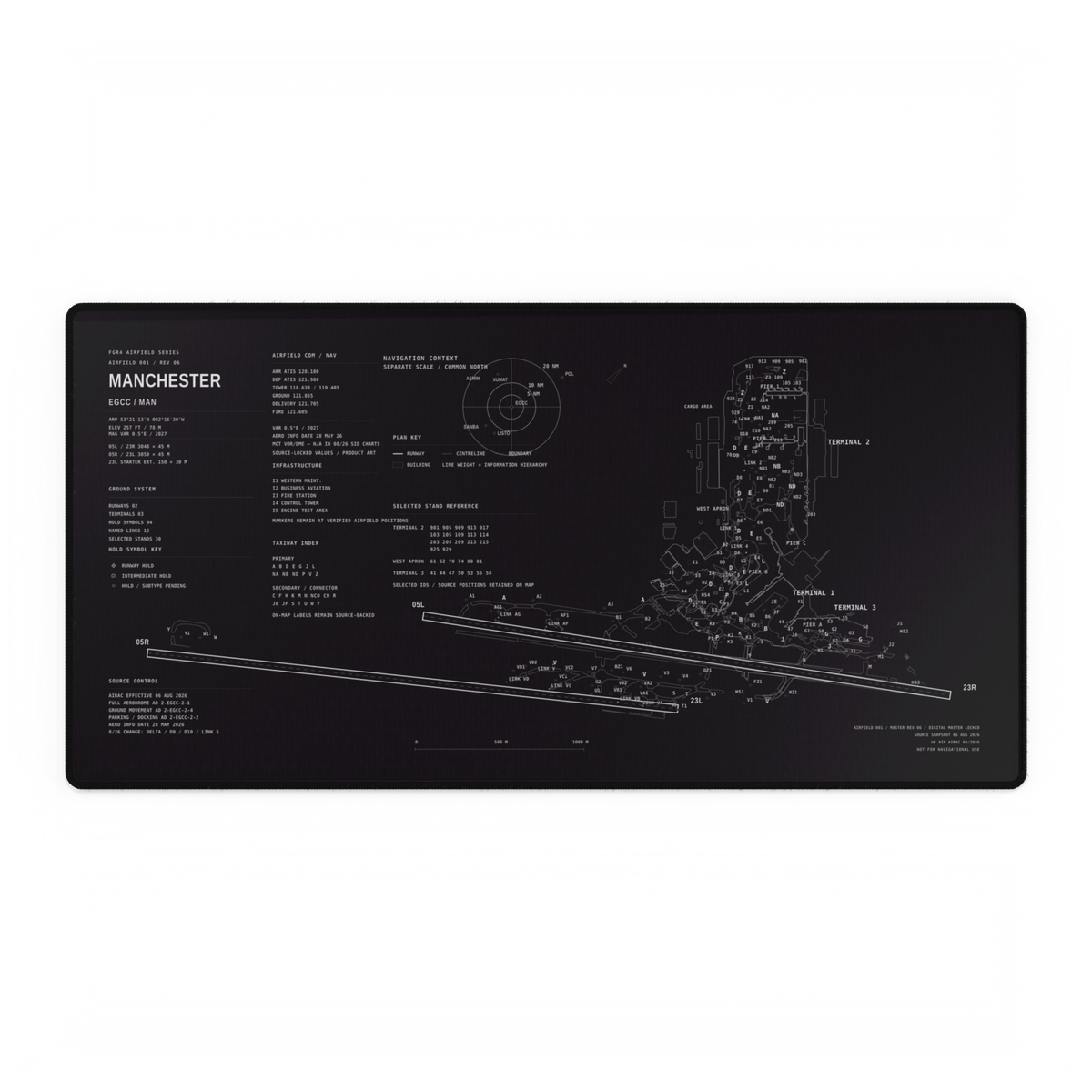
MAN and EGCC both identify Manchester Airport. MAN is its three-letter IATA code; EGCC is its four-letter ICAO code. The different labels belong to different systems, so seeing both on an airport artwork is not a contradiction.
One airport, two ways to identify it
The UK Civil Aviation Authority uses Manchester as an example in its reporting guidance (page 2), explicitly pairing MAN with IATA and EGCC with ICAO. Manchester Airport also uses EGCC on its own runway safety and aerodrome chart links.
IATA · three letters
Manchester in the commercial airline location-code system.
ICAO · four letters
Manchester in the location-code system used for flight operations.
Why do IATA and ICAO codes differ?
IATA’s location-code fact sheet distinguishes commercial airline purposes from flight operations. Its three-letter codes serve the commercial system; four-letter ICAO codes serve operational purposes and cover commercial and non-commercial airports.
There is a useful catch: an IATA code does not always identify one airport. IATA also assigns codes to cities, metropolitan areas and some intermodal locations, such as railway stations. Its example is WAS, the metropolitan-area code for Washington, D.C. Read the location name as well as the letters.
Read the label before the map
On the FGR4 Manchester airfield artwork shown above, the EGCC / MAN pairing sits beneath the airport name. Start there before tracing the runways and terminals: it tells you which place the drawing represents.
Neither airport code identifies an individual runway. If the labels beside the long strips are what caught your eye, our runway and taxiway guide takes you through that separate layer of the layout. The product image is artwork, not a current operational chart.
Try it with an airport you know
- Write down the airport’s full name and the code you have seen.
- Use the airport section of IATA’s official code search to check the three-letter identifier. Read the returned location carefully.
- For the four-letter identifier, check the airport’s official aeronautical information or its national aeronautical information publication. Record the source beside the code.
You now have a small reference label for your own collection: airport name, IATA code, ICAO code and source. If you are still choosing a subject for your desk, our aircraft versus airport-layout guide compares the two visual approaches.
Sources checked 24 September 2026. Hero image: owned FGR4 product artwork. Independent explainer; no airport or aviation-body endorsement is implied.