
Knowing the aircraft family is not always enough to choose the right aviation artwork. A Typhoon, Harrier or Spitfire can exist in several marks, variants, operators and individual airframes. If the artwork includes technical labels, squadron markings or a serial number, those details become part of the choice.
The safest method is simple: identify the highest level you can verify, then choose artwork that does not claim more certainty than you have. You can still buy a precise, meaningful piece without guessing the variant.
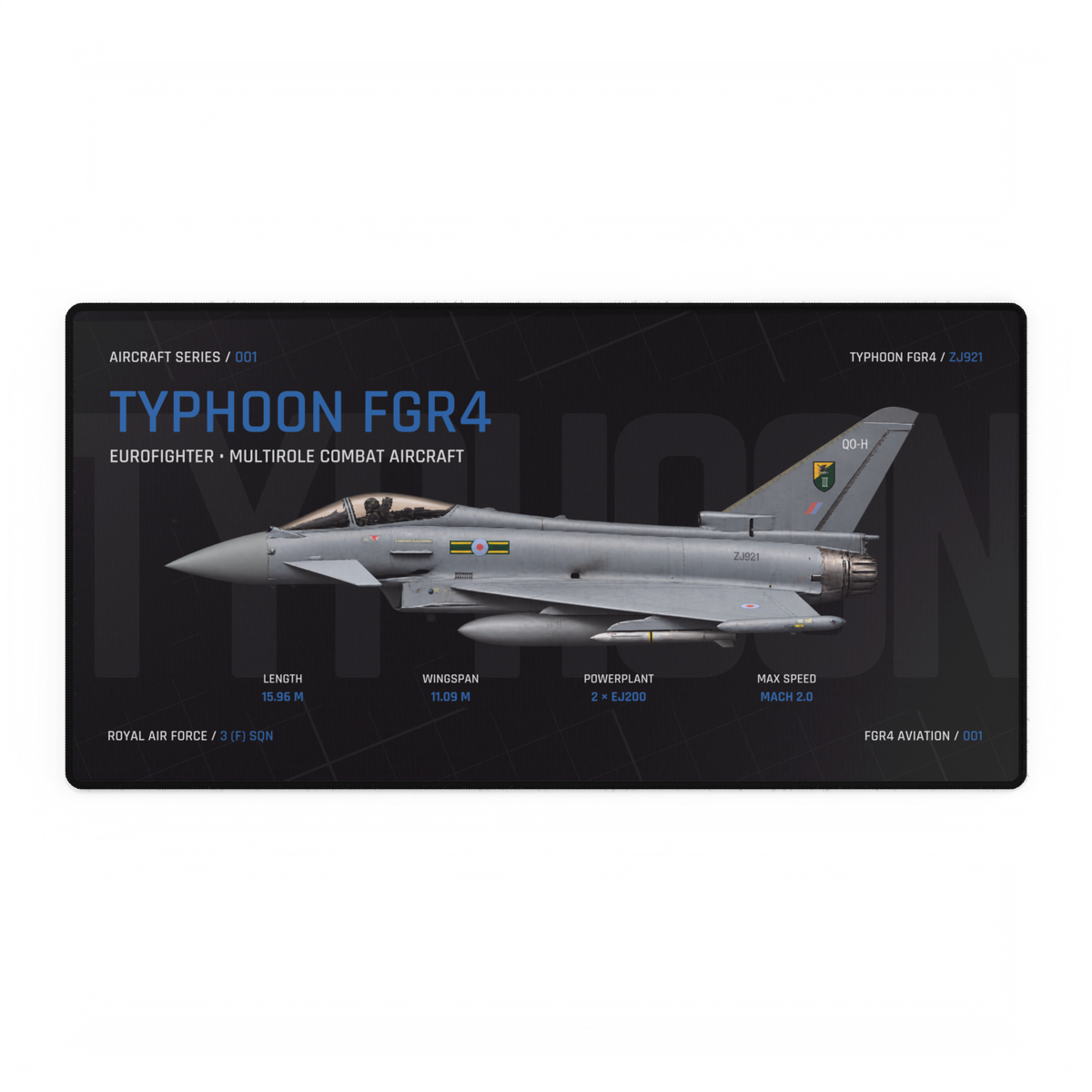
The live Typhoon design identifies the aircraft as an FGR4 and labels airframe ZJ921. It suits a buyer who wants that exact combination rather than a generic Typhoon reference.
Use the five-level certainty ladder
Work down this list and stop when the evidence becomes uncertain. Each level adds specificity, so each one needs its own proof.
- Aircraft family: the broad type, such as Typhoon, Harrier or Spitfire.
- Variant or mark: the exact version, such as Typhoon FGR4, Sea Harrier FA2 or Spitfire Mk I.
- Operator: the air force, navy or organisation that flew it.
- Unit: the squadron, test establishment or other operating unit.
- Individual airframe: the serial number or registration attached to one aircraft.
If you know only that somebody likes the Typhoon, level one is secure. If you also have a photograph clearly showing the aircraft caption or serial, you may be able to verify the remaining levels. The aim is not to force every purchase to level five. It is to match the artwork’s precision to the information you actually have.
Why the variant matters
Variants can change an aircraft’s role, equipment and visible shape. They also change the correct wording. An official Royal Air Force report, for example, refers specifically to the Typhoon FGR4 and the F-35B. Those letters and numbers are part of the aircraft designation, not decorative additions.
The same principle applies to historical subjects. “Spitfire” identifies a famous family, while “Spitfire Mk I” narrows the subject to a particular mark. A gift can still be welcome when only the family is known, but artwork carrying a precise mark or serial should be checked against the intended aircraft.
For a deeper look at why captions can change with the date and configuration, use the aircraft variant caption checklist.
Three questions to ask without spoiling a gift
You rarely need to announce that you are checking a present. These questions usually reveal enough:
- “Which version is your favourite?” Listen for a mark, role suffix or nickname rather than only the aircraft family.
- “Is there a particular squadron or airframe you follow?” This separates general interest from a personal connection to one unit or serial.
- “Do you prefer clean aircraft art or labelled technical artwork?” This tells you whether exact annotations add value for that person.
A saved photograph, airshow programme, model box or existing print may also contain the answer. Read the caption, then cross-check it with an official or specialist source instead of relying on the filename or a social-media description.
Choose one of three safe outcomes
THE VARIANT-CERTAINTY DECISION
Choose the labelled variant, operator and serial that match your evidence.
Choose artwork whose visible claims stay at family level, or ask one more question.
Pause the purchase and resolve the caption, date or airframe identity first.
What exact artwork looks like
FGR4’s Aircraft Series uses specific aircraft labels, so the product page should be read as part of the buying decision. The live Sea Harrier FA2 Aircraft Desk Mat identifies the Royal Navy FA2 airframe ZH796. The live Spitfire Aircraft Desk Mat labels a Spitfire Mk I, N3040. Those details make each piece more informative, but they also make an exact-match check worthwhile.
If the recipient simply loves aircraft profiles, browse the Aircraft Series and compare the full product titles and images. If the purchase depends on planform rather than captions, the F-22 versus F-35B silhouette guide shows how several structural clues work better than one feature alone.
How to verify a serial number
Serials are the most exact level of the ladder. Start by transcribing every character carefully; letters and numbers can be confused in small photographs. Then check an official fleet list, museum record or another source with clear provenance. The UK Ministry of Defence’s published tail-number list, for example, records ZJ921 as a Typhoon FGR4.
Next check the date. One airframe can change unit markings, paint scheme or role during its service life. A source may correctly identify the serial while showing it at a different time from the artwork. If the date, caption and visible markings do not agree, step back to a less specific choice.
A two-minute buying checklist
- Write down the aircraft family you know.
- Add the variant, operator, unit and serial only where you have evidence.
- Read the artwork title, product description and visible labels.
- Compare every specific claim with your notes.
- If one detail conflicts, choose a broader design or investigate before buying.
The best aviation gift is not automatically the most technical one. It is the one whose level of detail matches the recipient’s interest and the evidence available. Stop at the last rung you can verify, and the choice stays both personal and accurate.
Sources
- Royal Air Force: Typhoon FGR4 and F-35B deployment report
- UK Ministry of Defence: aircraft tail numbers and tail codes
Sources, products and related articles checked 21 October 2026. Product availability can change after publication. FGR4 Aviation is not presented as affiliated with or endorsed by the Ministry of Defence, the Royal Air Force, the Royal Navy or any operator.