
The Typhoon FGR4 is one of the most recognisable aircraft in modern Royal Air Force service.
Fast, agile and visually distinctive, it represents the sharp end of RAF combat air power. For many aviation enthusiasts, the Typhoon is the aircraft most closely associated with modern UK air defence, Quick Reaction Alert duties and front-line fast jet operations.
This Typhoon FGR4 fact file looks at the aircraft’s role, design, key features and why it has become such an important platform for RAF fans, pilots, spotters and military aviation enthusiasts.
What is the Typhoon FGR4?
The Typhoon FGR4 is the RAF’s multi-role version of the Eurofighter Typhoon.
It is designed to perform a range of combat air tasks, from air defence and air policing to ground attack and wider operational missions. This flexibility is one of the reasons the aircraft is so important to the RAF.
Rather than being built for one narrow role, the Typhoon FGR4 can be used across different mission types. That makes it a key part of the UK’s modern combat aircraft force.
What does FGR4 mean?
The FGR4 designation reflects the aircraft’s multi-role nature.
In RAF naming, FGR stands for Fighter, Ground attack and Reconnaissance. That gives a useful clue about what the aircraft is expected to do. It is not just an air-to-air fighter. It is also capable of strike and wider mission roles.
That multi-role identity is one of the reasons the Typhoon FGR4 has become such a major aircraft in RAF service.
RAF role and Quick Reaction Alert
One of the Typhoon FGR4’s most important roles is Quick Reaction Alert, often known as QRA.
QRA aircraft are kept ready to respond quickly to potential airspace threats or unidentified aircraft. For the UK, this role is central to air defence.
The Typhoon’s speed, climb performance, radar, weapons and readiness make it well suited to this task. For many people, the image of a Typhoon launching from an RAF station is closely tied to the idea of modern UK air defence.
The aircraft is also used for NATO air policing and overseas deployments, making it a visible part of Britain’s wider defence commitments.
Why the Typhoon looks so distinctive
The Typhoon has a very recognisable shape.
Its delta wing and canard layout give it a sharp, aggressive profile. The aircraft looks fast even when it is sitting still. From above, the broad delta planform is instantly recognisable, while the front profile gives the Typhoon a purposeful and compact appearance.
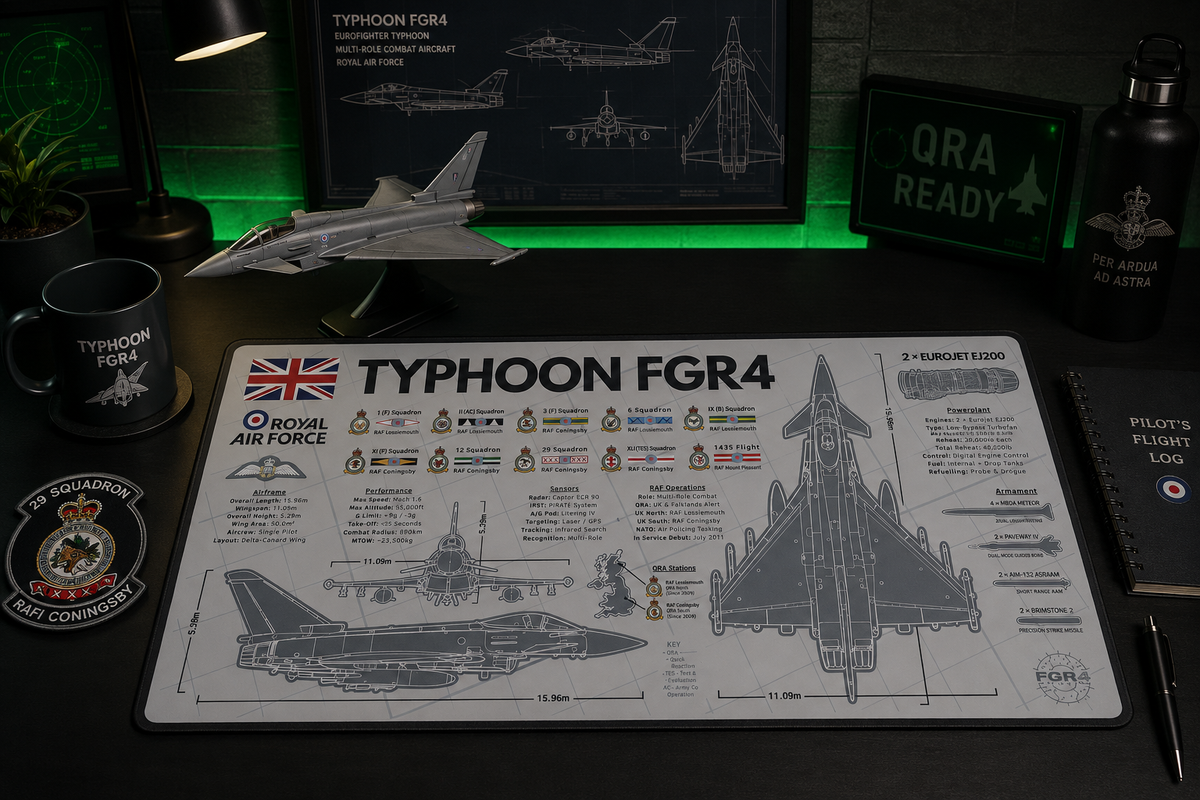
This is one of the reasons the aircraft works so well visually in aviation artwork, prints and desk mat designs. The silhouette is strong from multiple angles: top, side and front.
For aircraft enthusiasts, those shapes matter. A good Typhoon design should capture the airframe properly, not just use a generic fighter jet outline.
Engines and performance
The Typhoon is powered by two Eurojet EJ200 turbofan engines.
These engines are a major part of the aircraft’s performance identity. They give the Typhoon its speed, climb rate and agility, all of which are central to its role as a front-line combat aircraft.
For aviation fans, the twin-engine layout is also part of the aircraft’s visual character. From the rear, the engine spacing, exhausts and wing shape make the Typhoon instantly recognisable.
Weapons and mission flexibility
The Typhoon FGR4 can carry a range of air-to-air and air-to-surface weapons depending on the mission.
Its air defence role is supported by modern missiles, while its strike role allows it to carry precision-guided weapons. This flexibility is why the aircraft is often described as multi-role rather than simply a fighter.
For FGR4 designs, weapons and mission layouts are a key part of the visual story. They help show that the aircraft is not just a shape, but a working combat platform with a specific operational identity.
RAF squadrons and identity
Squadron identity is a huge part of the Typhoon story.
For many RAF fans, the aircraft itself is only one part of the appeal. The squadron badges, markings, stations and operational history all add another layer of meaning.
This is especially important for personalised aviation products. A Typhoon design becomes far more meaningful when it connects to a specific squadron, name, callsign or rank.
That is why the Typhoon FGR4 is such a strong platform for custom aviation desk mats and squadron-inspired designs.
Why aviation enthusiasts love the Typhoon FGR4
The Typhoon FGR4 has a lot of appeal because it combines modern performance with a clear RAF identity.
It is not a distant concept aircraft or a forgotten historic platform. It is a current, recognisable and operational aircraft that people can still see at airshows, RAF stations and in the news.
For aviation enthusiasts, that makes it feel immediate and relevant.
It also has the kind of design language that works well across different formats: models, prints, posters, flight sim setups, desk accessories and technical artwork.
Why the Typhoon works so well as a desk mat design
The Typhoon FGR4 is ideal for a technical aviation desk mat because it has strong details from every angle.
The top view shows the delta wing and canard layout. The side view shows the nose, canopy, intake area and rear profile. The front view highlights the aircraft’s stance and wing shape.
When combined with squadron details, engine data, weapon profiles and RAF-inspired visual elements, the result feels much more like a technical aircraft layout than a generic aviation graphic.
That is exactly the type of design that works well for aviation desk setups, flight sim spaces, home offices and RAF-themed workstations.
Final thoughts
The Typhoon FGR4 is one of the defining aircraft of the modern RAF.
Its multi-role capability, Quick Reaction Alert duties, distinctive airframe and strong squadron identity make it a favourite among RAF fans and military aviation enthusiasts.
Whether you are interested in the aircraft’s role, engineering, appearance or operational history, the Typhoon FGR4 is a platform with real presence.
Explore the FGR4 Typhoon collection, including technical aviation desk mats designed for RAF fans, pilots, flight sim users and military aircraft enthusiasts.