
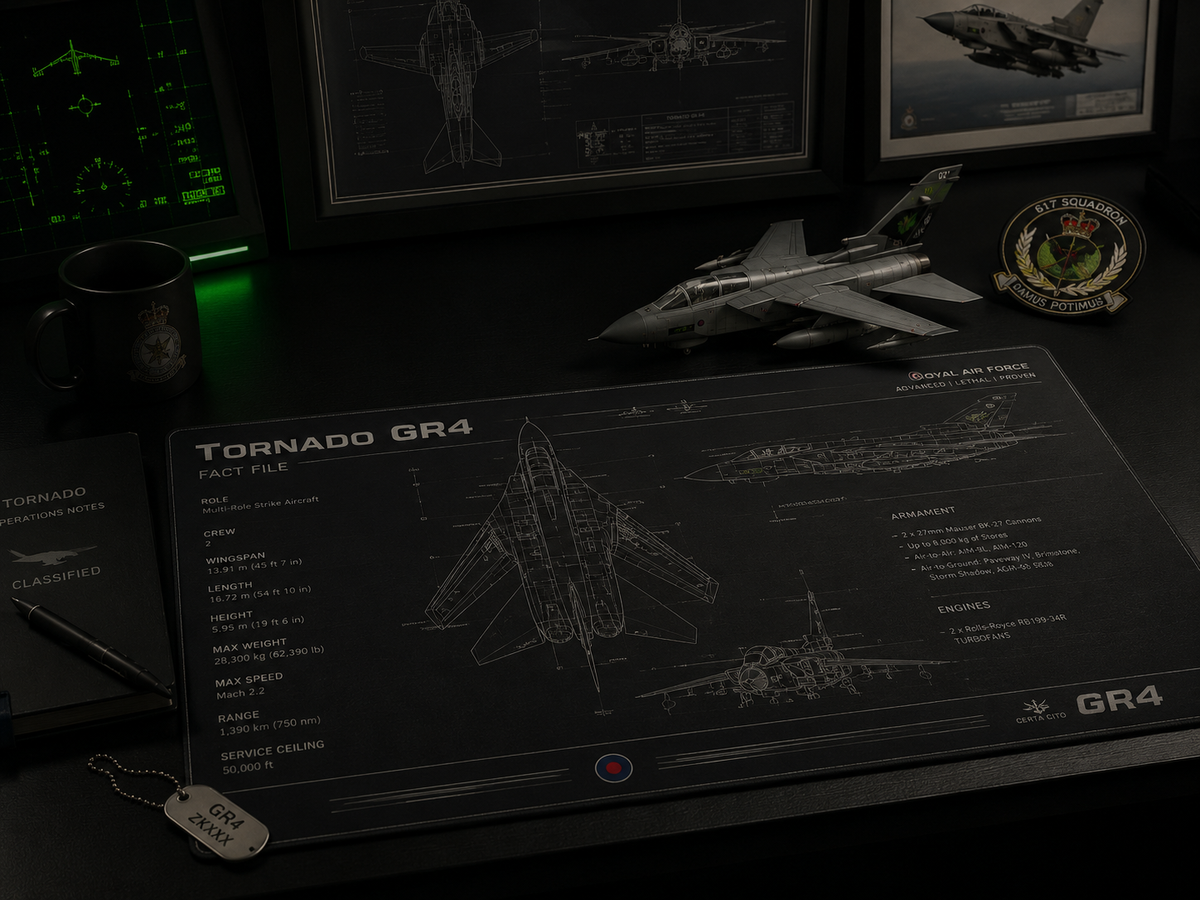
The Tornado GR4 is one of the most iconic RAF aircraft of the modern era.
For many aviation enthusiasts, it represents a particular kind of fast jet: low-level, powerful, purposeful and instantly recognisable. Its swing-wing design, two-seat cockpit, terrain-following role and long operational history made it one of the defining aircraft of British air power for decades.
Even after retirement, the Tornado GR4 still has a huge following among RAF fans, aircraft spotters, veterans, model collectors and military aviation enthusiasts.
This is why the Tornado remains such an important aircraft to understand — and why it still deserves a place in aviation collections today.
What was the Tornado GR4?
The Tornado GR4 was the upgraded RAF strike and attack version of the Panavia Tornado.
It was designed for demanding operational roles, including low-level strike, reconnaissance and precision attack. Unlike modern stealth aircraft, the Tornado had a more mechanical, muscular look. It felt like a machine built for hard use, difficult weather, long missions and serious operational work.
That is a big part of its appeal.
The Tornado was not delicate or subtle in appearance. It looked like a proper strike aircraft.
Why the Tornado’s swing-wing design mattered
The Tornado’s most famous feature was its variable-sweep wing, often called a swing wing.
This allowed the aircraft’s wings to change position depending on the phase of flight. With the wings extended, the aircraft had better lift and control at lower speeds. With the wings swept back, it was better suited to high-speed flight.
Visually, this made the Tornado stand out immediately.
On the ground, at take-off, in low-level passes or parked with the wings swept, the aircraft had a look that few modern jets can match. For enthusiasts, the swing-wing shape is one of the reasons the Tornado remains so memorable.
The Tornado and low-level flying
One of the reasons the Tornado became so strongly associated with RAF culture was its low-level role.
The aircraft was designed for fast, low-level penetration missions, using terrain, speed and advanced systems to reach a target area. This made it a favourite with aircraft photographers and spotters, especially in areas known for military low flying.
The Tornado had presence.
Its shape, sound and attitude made it feel different from other aircraft. It was not just another grey jet. It had character.
RAF service and operational history
The Tornado served the RAF for nearly 40 years and became closely linked with British military operations from the late Cold War through to the modern era.
It saw service across several major operational periods and became one of the RAF’s most recognisable front-line aircraft. For many people, the Tornado GR4 is associated with RAF Marham, deployed operations, long-range strike missions and the transition from Cold War fast jet thinking into modern precision air power.
That long service life is one of the reasons it still matters.
Aircraft that serve for that long become more than equipment. They become part of the identity of the people, squadrons and stations around them.
Why RAF fans still love the Tornado GR4
The Tornado GR4 has remained popular because it has everything aviation enthusiasts tend to connect with.
It has a distinctive shape. It has a proper operational story. It has squadron history. It has a recognisable sound. It has a cockpit built for two crew. It has the drama of the swing wing. It has the look of a serious strike aircraft.
It also belongs to a generation of aircraft that felt mechanical and physical in a way that modern platforms sometimes do not.
For many enthusiasts, that makes the Tornado more emotionally powerful than newer aircraft.
The Tornado’s replacement and legacy
The retirement of the Tornado marked a major shift in RAF combat aircraft history.
As the Tornado left service, the RAF moved further into a force built around aircraft such as the Typhoon FGR4 and F-35B Lightning II. Those aircraft bring newer sensors, weapons, roles and operational approaches.
But the Tornado’s legacy did not disappear.
It helped shape decades of RAF strike operations, influenced generations of crews and remains one of the aircraft people most strongly associate with British fast jet history.
Why the Tornado works as an aviation desk mat design
From a design perspective, the Tornado is perfect for a technical aviation desk mat.
The side profile is long, sharp and purposeful. The top-down view is instantly recognisable because of the variable-sweep wings. The front profile has a distinctive twin-intake, two-seat strike aircraft feel.
The aircraft also has strong supporting details: squadron identity, weapons, engine information, low-level strike role, RAF station links and Cold War-to-modern operational history.
That gives a Tornado design a lot of visual depth.
It is not just a fighter jet shape. It is a platform with history, purpose and atmosphere.
What makes the Tornado different from the Typhoon?
The Tornado and Typhoon both have strong RAF identities, but they feel very different.
The Typhoon FGR4 represents modern multi-role combat air power, Quick Reaction Alert, agility and current RAF fast jet presence.
The Tornado GR4 feels more like a strike aircraft from another era: low-level, rugged, mechanical and mission-focused.
That difference is exactly why both aircraft have such strong followings.
One feels like the modern RAF front line. The other feels like the legend that helped define the decades before it.
Final thoughts
The Tornado GR4 remains one of the great RAF aircraft.
Its swing-wing design, strike role, long service life and unmistakable character make it a platform that still means a lot to aviation enthusiasts. Even though it is no longer in RAF service, its presence is still felt through museums, memories, models, photographs, squadron history and the enthusiasm of people who still see it as one of Britain’s most important fast jets.
For FGR4, the Tornado is exactly the kind of aircraft that deserves a detailed, aircraft-first design.
A new Tornado platform file is entering the hangar soon.