
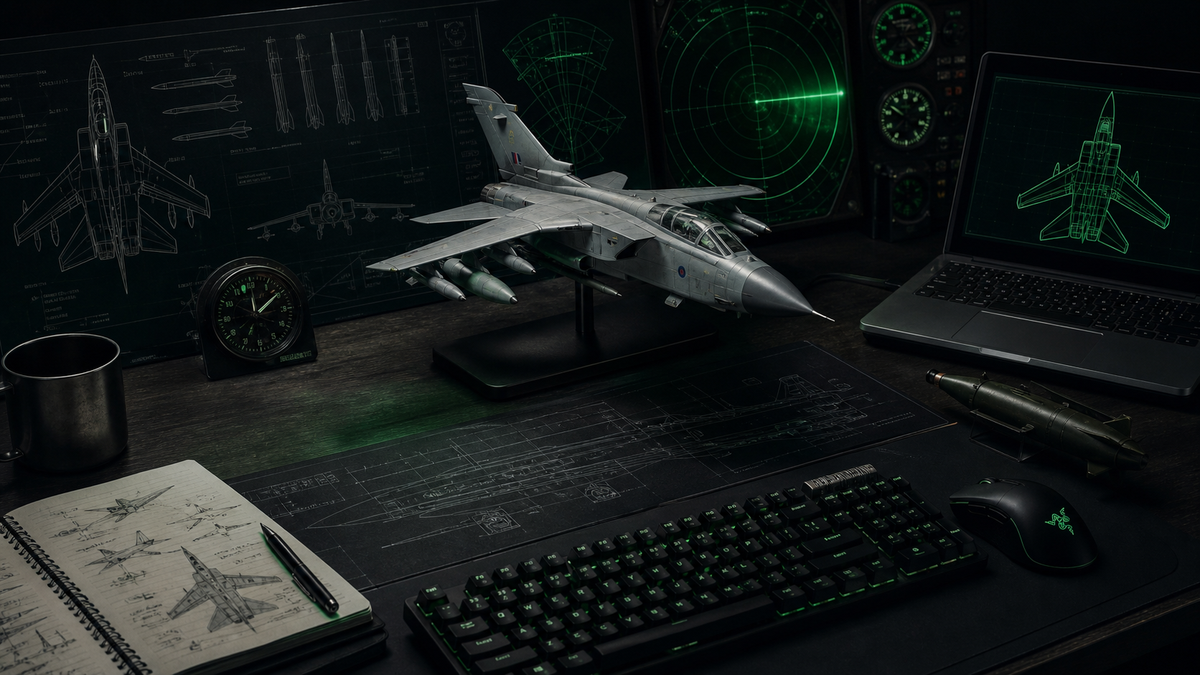
The Tornado GR4 still earns attention because it was built for a specific job and looked like it meant it. Low-level strike, terrain-following flight, long service in RAF operations and that unmistakable swing-wing silhouette gave it a presence few modern aircraft can match.
That is exactly why the aircraft works so well in desk setup form. A good aviation workspace needs a subject with shape, identity and a clear service story. The Tornado GR4 has all three, whether you know it from the final years of RAF Germany, Operation Telic, Operation Herrick or the type's last chapter before retirement in 2019.
This fact file looks at what made the GR4 distinct, why it remains such a strong RAF design subject, and how that carries through into products like the Royal Air Force Tornado GR4 Desk Mat.
Why the Tornado GR4 still stands apart
The Tornado was never a delicate aircraft. It was a practical strike platform designed around speed at low altitude, heavy stores carriage and all-weather mission work. By the GR4 era, the aircraft had matured into a capable attack and reconnaissance asset with upgraded avionics, navigation systems, targeting integration and a cockpit layout suited to the RAF's late-Cold War and post-Cold War mission set.
The visual identity matters here. The variable-geometry wings, high-mounted tail, broad fuselage shoulders and nose-down stance give the Tornado GR4 a very different character from lighter or more obviously agile fighters. Even parked, it looks engineered for tasking rather than display.
For aviation enthusiasts, that makes it memorable. For a desk mat or print layout, it makes the aircraft easy to recognise from multiple angles, which is critical for technical product artwork.
What the GR4 upgrade changed
The GR4 standard was not just a new label on an older airframe. It reflected the RAF's need to keep the Tornado relevant in an era of precision weapons, night operations and expeditionary campaigning. The aircraft gained modernised avionics, improved navigation and attack capability, and better compatibility with later targeting and weapon systems.
In practical terms, that meant a platform that could move beyond classic low-level strike imagery and continue serving as a serious operational aircraft in the Balkans, Iraq, Afghanistan and against Daesh. The GR4 became the Tornado most RAF followers remember because it represented the type at full maturity.
That service life is part of the appeal. The aircraft feels substantial, not nostalgic for the sake of it. It carries real front-line history.
Why it works as a desk setup subject
Some aircraft are important in service but visually awkward on the desk. The Tornado is the opposite. The planform reads cleanly, the wing geometry adds instant personality and the aircraft suits darker technical presentations better than bright poster-style treatment.
The Royal Air Force Tornado GR4 Desk Mat makes sense for that reason. It gives a workspace an aircraft-first centrepiece without relying on loud graphics. The jet already carries enough visual weight. A cleaner technical layout lets the shape and RAF context do the work.
If you prefer a broader service view rather than a single-aircraft focus, the Royal Air Force 2026 Fleet Desk Mat is a useful companion piece because it places the Tornado inside the wider story of RAF fleets past and present.
Tornado, Typhoon and the shift in RAF fast-jet identity
One reason the GR4 remains relevant is that it sits at a turning point in RAF fast-jet history. It belongs to the era before the Typhoon fully defined current RAF quick reaction and multi-role identity, yet it also overlaps with the precision-strike expectations that shaped modern air operations.
That makes it a strong comparison aircraft. The Royal Air Force Typhoon FGR4 Desk Mat represents the sharper, newer fast-jet chapter. The Tornado feels heavier, more weathered and more mission-workmanlike. Many collectors want both because they tell different parts of the same RAF story.
The same applies if you follow the transition into fifth-generation capability. A Royal Air Force F-35B Lightning Desk Mat shows where UK combat aviation moved next, but the Tornado GR4 remains the aircraft that bridged older strike doctrine and the precision campaign era many enthusiasts still remember most clearly.
Best suited readers and setups
The Tornado GR4 theme is especially strong for RAF enthusiasts who prefer aircraft with operational depth rather than just clean modern lines. It suits study spaces, darker office setups, sim corners and collector desks where the aim is to create a briefing-room feel rather than a generic gaming backdrop.
It also works well as a gift subject. People who served around Tornado units, grew up with RAF low-level strike imagery or followed the type through its final years usually recognise it instantly. That familiarity makes the aircraft-specific product feel considered rather than random.
- Collectors get a clear aircraft profile with real RAF context.
- Sim pilots get a workspace subject tied to strike aviation rather than generic jet art.
- Gift buyers get an aircraft that feels specific, knowledgeable and easy to place.
Final approach
The Tornado GR4 still feels right on the desk because it brings shape, mission history and RAF character in one airframe. It is not just famous; it is visually useful. That is a big difference when turning aircraft into premium desk products.
If you want a single-aircraft strike aviation centrepiece, start with the Tornado. If you want to place it inside a bigger service story, look across the wider FGR4 product collection and then return to the news feed for more DISPATCH BRIEFs on RAF aircraft, desk setups and product design.