
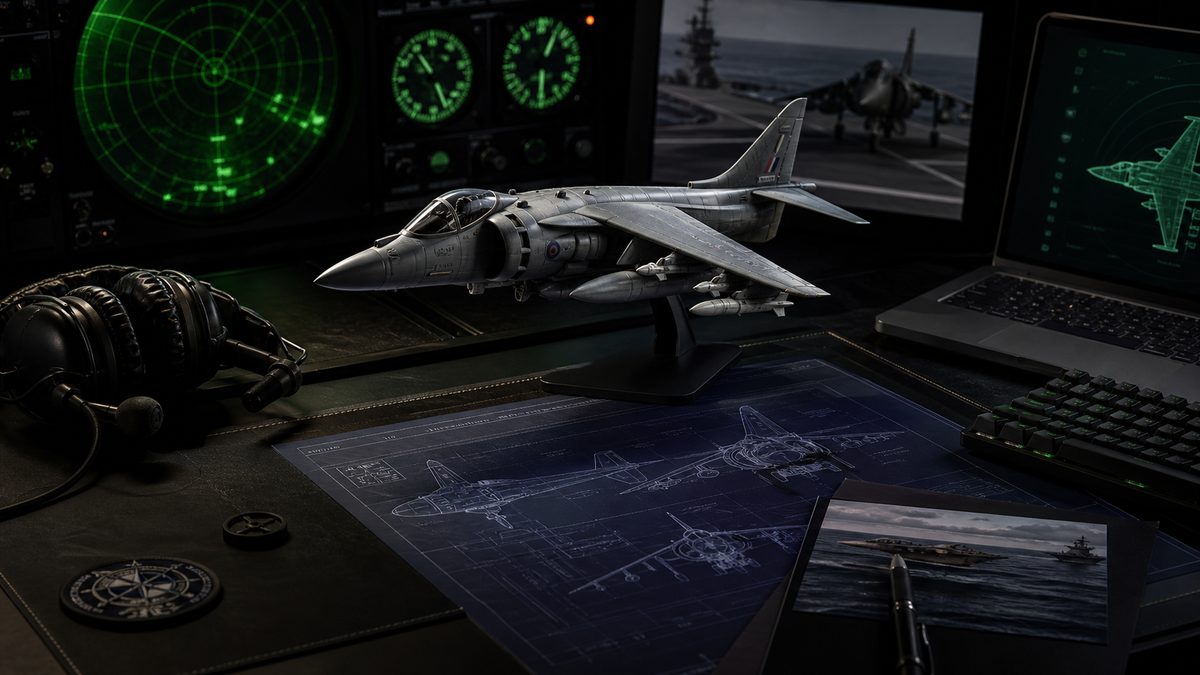
The Sea Harrier FA2 remains one of the clearest examples of an aircraft with a job, a silhouette and a service story that still feel sharp decades later. For Royal Navy aviation fans, it is not just another retired fast jet. It is the fleet defender that carried the later-generation Blue Vixen radar, retained the compact Harrier stance, and gave British carrier aviation a distinctive all-weather fighter identity.
That combination is exactly why the aircraft works so well as a desk mat subject. It is visually recognisable, technically interesting and closely tied to a specific Royal Navy chapter rather than vague general aviation nostalgia.
This fact file looks at what made the FA2 different, why its proportions still read so well in product design, and where it sits inside a modern FGR4 Aviation setup.
What the FA2 actually added
The earlier Sea Harrier FRS1 already had a strong reputation for compact carrier operations, but the FA2 brought a more capable fleet-defence focus. The most important change was the Blue Vixen radar, which gave the aircraft a more credible beyond-visual-range fighting capability and pushed it beyond the simpler image of a short-deck jump jet.
That matters because the FA2 was not interesting only for its take-off and landing method. It was interesting because it paired STOVL flexibility with a serious radar fit, a sharper nose profile and a more complete interceptor identity. For aviation enthusiasts, those details give the aircraft substance. For product design, they give it a shape that feels purposeful rather than decorative.
The first natural product link here is the Royal Navy Sea Harrier FA2 Desk Mat, because it keeps that aircraft-first identity intact instead of reducing the FA2 to a generic naval silhouette.
Why the Sea Harrier still stands out visually
Some aircraft look strong only in photographs taken from one angle. The Sea Harrier FA2 is not one of them. The raised cockpit line, intake arrangement, compact fuselage, high-mounted wing and sharply extended nose all help it read clearly in side profile, planform and technical layout views.
That is useful on a desk mat because aviation artwork has to work under real objects. Keyboards, mice, notebooks and laptops always obscure part of the surface. An aircraft with a weak outline disappears quickly. The FA2 does not. Even when only part of the layout is visible, the aircraft still feels specific.
It also carries the right kind of Royal Navy identity for a premium workspace. The FA2 suggests carriers, fleet air defence and late-Cold War to post-Cold War British naval aviation without requiring loud visual treatment. That restraint fits the FGR4 house style far better than over-designed novelty graphics.
How it compares with newer UK fast-jet subjects
The Sea Harrier belongs to a different era from the F-35B, but the comparison is still useful. The Royal Navy F-35B Lightning Desk Mat reflects the modern carrier-strike picture: stealth shaping, integrated sensors and a broader UK-US programme story. The FA2, by contrast, feels tighter and more mechanical. It represents a period when the aircraft's role and shape were immediately legible.
That contrast is part of the appeal. A Sea Harrier setup leans into compact fleet-defence character. An F-35B setup leans into contemporary carrier aviation. Both work, but they produce a different mood on the desk.
If you want a wider RAF and Royal Navy reference point around the FA2 rather than a single-aircraft setup, the Royal Air Force 2026 Fleet Desk Mat adds broader context by placing current British air power into one coordinated view. It works especially well for enthusiasts who like to balance heritage aircraft appreciation with an eye on the present force mix.
Why it suits an aviation workspace
A good aviation desk setup needs more than a good-looking aircraft. It also needs a subject that supports the kind of atmosphere FGR4 is building: premium, technical and deliberate. The Sea Harrier FA2 fits because it has enough engineering character to reward a closer look, yet the outline is compact enough to sit comfortably in a workstation environment.
That makes it a strong choice for collectors, former cadets, sim pilots and gift buyers who want a desk surface with clear subject matter rather than generic military styling. The aircraft feels informed. It tells the viewer that the design choice was made on purpose.
On the wall, the Royal Air Force 2026 Fleet Poster can complement that desk-first approach by adding a wider aircraft index nearby, while the Sea Harrier mat keeps the actual working area focused and usable.
What makes the FA2 a strong product story
FGR4 pieces work best when the aircraft brings both visual clarity and service identity. The FA2 does that neatly. It is associated with Royal Navy operations, carrier decks and British fleet air defence, but it never feels overexposed in the way some modern subjects do. That gives it a collector's quality.
It also avoids the trap of being admired only for nostalgia. The FA2 still holds up because the underlying aircraft design is disciplined. The nose, canopy line, wing geometry and naval mission set all point in the same direction. For a premium desk mat or poster-led workspace, that coherence matters.
Final approach
If the goal is to build an aviation desk setup with real Royal Navy character, the Sea Harrier FA2 is one of the best places to start. It is technically interesting, visually compact and specific enough to feel premium rather than generic.
Start with the Royal Navy Sea Harrier FA2 Desk Mat as the centrepiece, then broaden the setup only where it adds context. For more aircraft-led workspace options, explore the full FGR4 product collection or browse the FGR4 news feed for more dispatch briefs.