
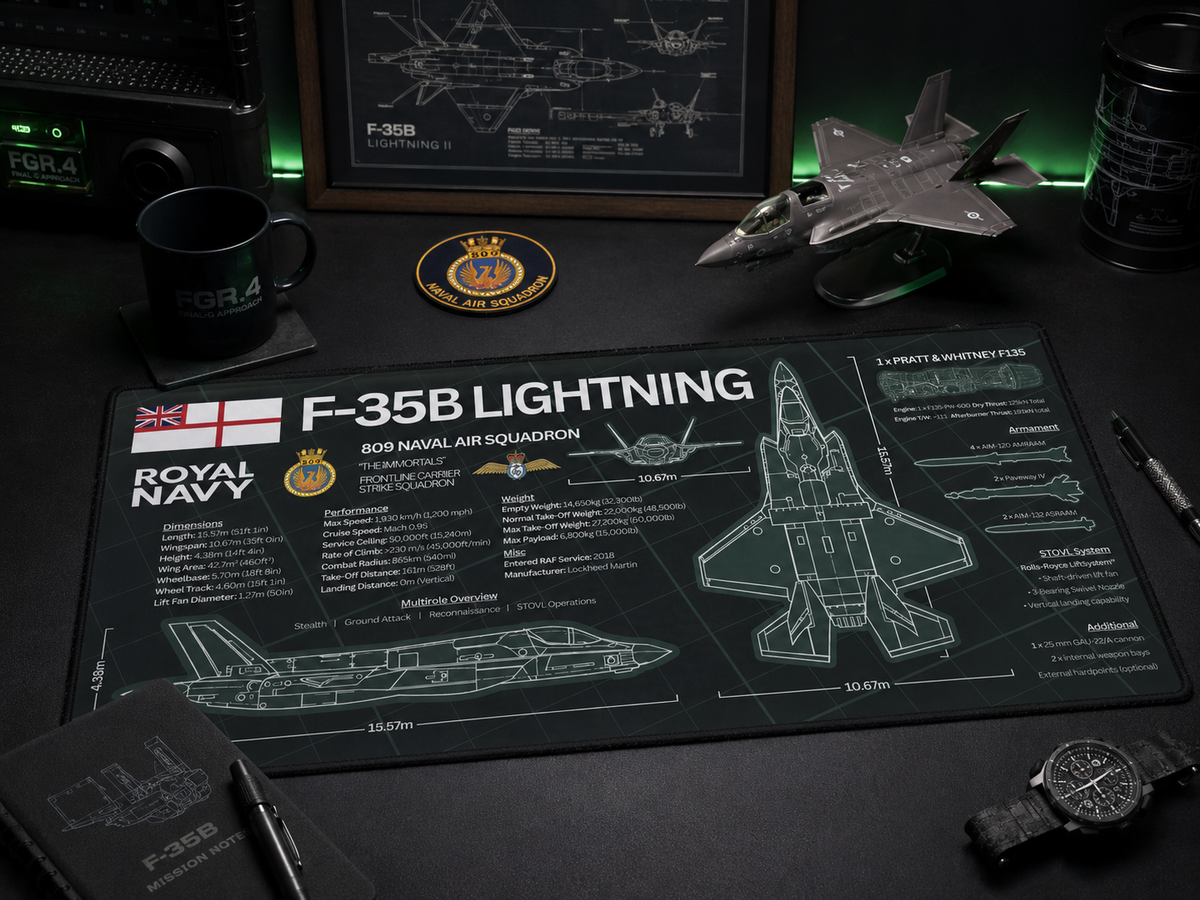
The F-35B Lightning II is one of the most advanced aircraft in UK service.
Used by the RAF and Royal Navy, it represents a major shift in British air power: stealth, sensors, data-sharing, carrier operations and short take-off and vertical landing capability all built into one aircraft.
For aviation enthusiasts, the F-35B is not just another modern fighter. It is the aircraft that connects the RAF, Royal Navy, Queen Elizabeth Class carriers and fifth-generation combat aviation.
This fact file explains what makes the F-35B different, why the UK uses this variant and why it has become such an important aircraft for modern military aviation fans.
What is the F-35B Lightning II?
The F-35B Lightning II is the short take-off and vertical landing variant of the Lockheed Martin F-35 family.
Unlike the F-35A, which uses conventional runways, and the F-35C, which is designed for catapult-assisted carrier operations, the F-35B can operate from shorter runways and aircraft carriers without catapults.
That makes it especially important for the UK because it can operate from the Royal Navy’s Queen Elizabeth Class aircraft carriers.
The RAF describes the Lightning as a stealth multi-role aircraft capable of air-to-surface, electronic warfare, intelligence gathering and air-to-air missions. That makes it much more than a simple fighter jet. It is a combat aircraft, sensor platform and information-sharing asset all in one.
Why does the UK use the F-35B variant?
The UK uses the F-35B because of its STOVL capability.
STOVL stands for short take-off and vertical landing. This allows the aircraft to take off from a short carrier deck and land vertically, making it suitable for carrier strike operations from HMS Queen Elizabeth and HMS Prince of Wales.
This is one of the biggest reasons the F-35B is so important to both the RAF and Royal Navy.
It gives the UK a modern stealth aircraft that can operate from land bases and from aircraft carriers. That flexibility makes it a central part of British carrier strike capability.
RAF and Royal Navy operation
One of the most interesting things about the F-35B in UK service is that it connects both the RAF and Royal Navy.
The aircraft is flown as part of the UK Lightning Force, with RAF and Royal Navy personnel both involved in the capability. This joint identity is part of what makes the UK F-35B story different from many other aircraft.
For RAF fans, the F-35B sits alongside the Typhoon FGR4 as part of the modern combat air fleet.
For Royal Navy aviation fans, it represents the return of fixed-wing fast jet operations to British aircraft carriers.
That dual identity makes the F-35B especially strong as an aviation design subject.
809 Naval Air Squadron and carrier aviation
809 Naval Air Squadron is one of the most important names connected to the Royal Navy F-35B.
The Royal Navy says 809 Naval Air Squadron was originally formed in 1941 and has been resurrected as the first Royal Navy formation to fly the Lightning II aircraft. RAF Marham also records that 809 NAS became the nation’s second front-line fighter unit operating the F-35B Lightning in 2023.
For aviation enthusiasts, that matters because squadron identity gives the aircraft a deeper story. The F-35B is not just a stealth jet. It is also part of a wider Fleet Air Arm and carrier aviation lineage.
What makes the F-35B different visually?
The F-35B has a very different look from older British fast jets.
Where the Tornado GR4 looked rugged and mechanical, and the Typhoon FGR4 looks sharp and agile, the F-35B has a compact stealth shape. Its lines are smoother, its surfaces are more blended and its proportions are shaped around low observability.
From above, the aircraft has a very recognisable fifth-generation planform. From the side, the short nose, single engine and thick fuselage give it a distinctive appearance. From the front, the intake shape and wide stance make it look very different from the Typhoon or Tornado.
That makes the F-35B an excellent aircraft for blueprint-style desk mat design because the shape is instantly tied to modern stealth aviation.
STOVL and the LiftFan system
The F-35B’s most famous technical feature is its STOVL system.
This includes the shaft-driven LiftFan system and a swivelling rear nozzle, allowing the aircraft to perform short take-offs and vertical landings. This capability is what separates the F-35B from the F-35A and F-35C.
For aviation fans, this is one of the most interesting engineering details on the aircraft. It also links the F-35B to earlier British and naval aviation culture, where vertical and short take-off aircraft have always had a strong following.
Why the F-35B matters to modern UK air power
The F-35B matters because it gives the UK a stealthy, data-driven, carrier-capable aircraft.
Its value is not just about speed or weapons. It is also about sensors, situational awareness, information-sharing and the ability to operate as part of a wider force.
In simple terms, the F-35B is designed to see, share and act in a modern battlespace.
That is why it is often discussed differently from older aircraft. The aircraft itself is important, but so is the information it gathers and shares with other platforms.
Why aviation enthusiasts are drawn to the F-35B
The F-35B has a different kind of appeal from older RAF and Royal Navy aircraft.
Some enthusiasts love it because it represents the future of British air power. Others are drawn to its carrier role, stealth design, advanced cockpit, STOVL system or connection to the Queen Elizabeth Class carriers.
For Royal Navy aviation fans, it also carries the weight of being the aircraft that returned fixed-wing fast jet power to the carrier deck.
For RAF fans, it adds a fifth-generation aircraft alongside the Typhoon.
That combination makes it one of the most important aircraft in the modern UK military aviation story.
Why the F-35B works as an aviation desk mat design
The F-35B works extremely well as a technical desk mat because it has a clear aircraft identity.
The top view shows the stealth planform. The side view highlights the compact fuselage and single-engine layout. The front view shows the wide stance and modern intake shape. Supporting details such as STOVL information, engine data, squadron identity and Royal Navy or RAF markings help give the design more meaning.
A Royal Navy F-35B design can lean into 809 Naval Air Squadron, carrier strike and Fleet Air Arm identity.
An RAF F-35B design can focus more on Lightning Force, modern combat air, stealth and the aircraft’s role alongside the Typhoon.
That makes the F-35B one of the strongest platforms for aviation desk mat design.
F-35B, Typhoon and the future of UK fast jets
The F-35B and Typhoon FGR4 are very different aircraft, but together they represent the modern UK fast jet force.
The Typhoon brings speed, agility, QRA identity and a strong RAF front-line presence.
The F-35B brings stealth, sensors, carrier capability and fifth-generation information-sharing.
For aviation enthusiasts, the contrast between the two aircraft is part of what makes the current RAF and UK combat aircraft story so interesting.
One is the visible, powerful defender of UK skies. The other is the stealthy, data-focused aircraft built for modern operations and carrier strike.
Final thoughts
The F-35B Lightning II is one of the most important aircraft in modern UK service.
It connects the RAF, Royal Navy, Queen Elizabeth Class carriers, stealth aviation, STOVL engineering and the future of British combat air power.
For enthusiasts, it has the right mix of technical detail, service identity and visual presence to make it a standout aircraft.
Whether you are drawn to the RAF version, the Royal Navy carrier aviation story or the engineering behind STOVL flight, the F-35B is a platform with serious significance.
Explore FGR4 F-35B aviation desk mats designed for RAF fans, Royal Navy aviation followers, flight sim users and modern military aircraft enthusiasts.