
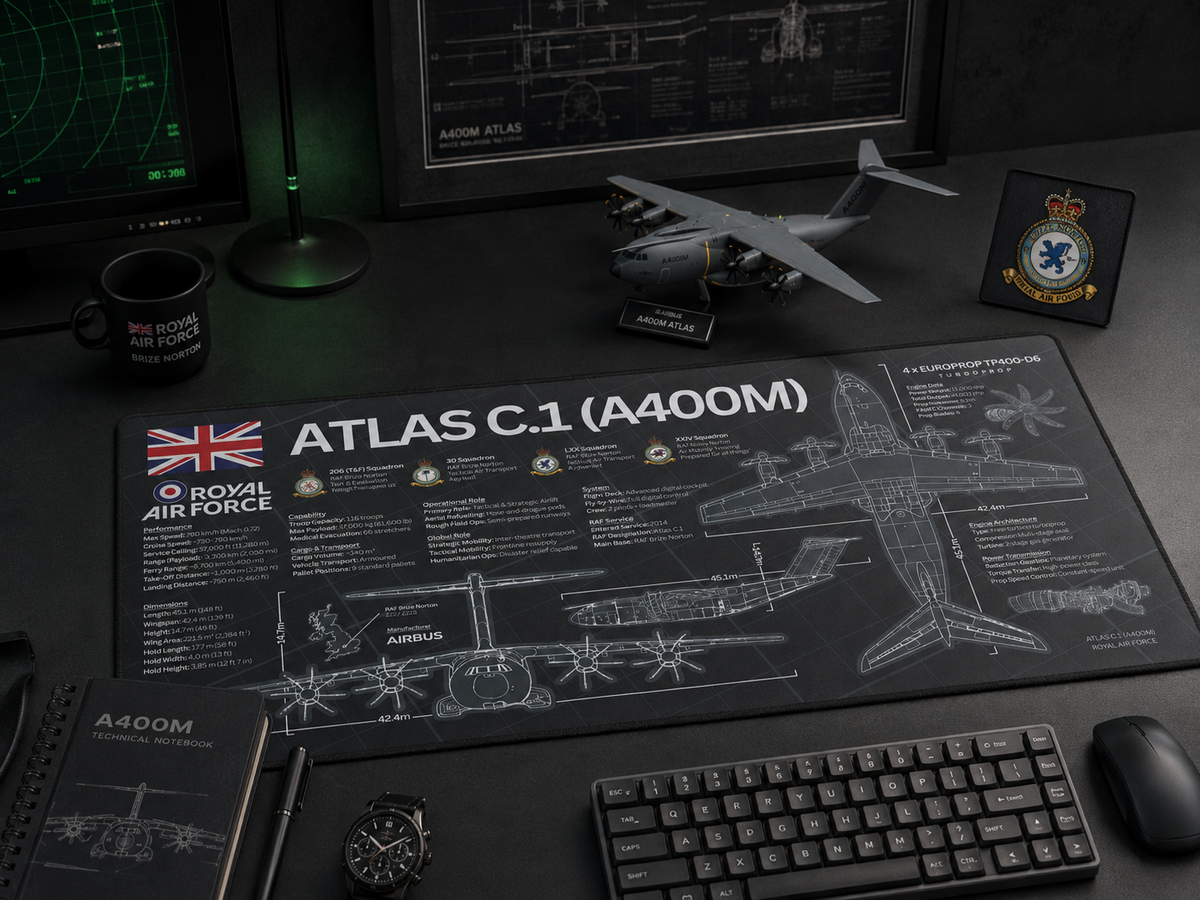
The A400M Atlas C.1 is one of the most important aircraft in the modern Royal Air Force fleet.
It may not have the same fast jet drama as the Typhoon FGR4 or F-35B Lightning II, but the Atlas is a serious capability aircraft. It moves people, equipment, vehicles, supplies and medical support across long distances, including into difficult locations where larger aircraft may not be suitable.
For aviation enthusiasts, the A400M Atlas is fascinating because it combines the scale of a strategic airlifter with the flexibility of a tactical transport aircraft.
This fact file looks at the RAF Atlas C.1, what it does, why it matters and why it has become such a distinctive platform in modern military aviation.
What is the A400M Atlas C.1?
The A400M Atlas C.1 is the RAF’s version of the Airbus A400M military transport aircraft.
It is a four-engine turboprop airlifter designed for tactical and strategic transport missions. In simple terms, that means it can move heavy loads over long distances, but it can also operate into more difficult airfields closer to where support is needed.
That combination is what makes the Atlas so useful.
It is larger than older tactical transport aircraft, but more flexible than many traditional heavy airlifters. It gives the RAF an aircraft that can support operations, exercises, humanitarian missions and rapid global movement.
Why the Atlas matters to the RAF
The Atlas matters because air mobility is one of the most important parts of any modern air force.
Fast jets may get more attention, but transport aircraft keep operations moving. They carry people, vehicles, equipment, aid, supplies and specialist loads. Without aircraft like the Atlas, military operations become much harder to support.
The RAF highlights that the Atlas can carry heavy payloads into established and remote civilian or military airfields, including short, unprepared or semi-prepared strips. That ability makes it extremely valuable for operations where access is limited or infrastructure is poor.
In other words, the Atlas is built to get important equipment and people where they need to be.
Tactical and strategic airlift explained
The A400M is interesting because it sits between tactical and strategic airlift roles.
Strategic airlift usually means moving large loads over long distances. Tactical airlift usually means moving people or cargo closer to the front line, often into more demanding airstrips or operating areas.
The Atlas can do both.
That is why it is such a useful aircraft for the RAF. It has the range and payload to support long-distance movement, but it also has the design features needed for tactical operations.
This mix of roles gives the aircraft a much wider purpose than simply moving cargo from one large airport to another.
Payload, passengers and medical evacuation
The Atlas is designed around flexibility.
Depending on the mission, it can carry troops, pallets, vehicles, medical evacuation equipment or mixed loads. The RAF states that the aircraft can carry 116 passengers, 9 aircraft pallets and 54 passengers, or 66 stretchers, with a maximum payload of 37 tonnes.
That makes it suitable for a wide range of missions, from military deployment to humanitarian response.
This is one of the reasons the Atlas is such a strong aircraft for modern RAF operations. It can be reconfigured depending on what is needed.
Operating from difficult airfields
One of the Atlas C.1’s most important advantages is its ability to operate from challenging locations.
The aircraft is designed to land on short, unprepared or semi-prepared strips. This means it can reach areas that may not have major airport infrastructure.
That matters for military operations, disaster relief and remote deployments.
It also gives the aircraft a more rugged identity than a normal transport aircraft. The Atlas is not just a large cargo aircraft designed for clean runways. It is built to operate closer to the point of need.
The distinctive A400M design
The A400M Atlas has a very recognisable shape.
Its high wing, T-tail, large cargo fuselage and four massive turboprop engines give it a strong presence. The eight-bladed propellers are especially distinctive and help separate it visually from jet-powered airlifters.
From the front, the aircraft looks broad and powerful. From the side, the large cargo hold and raised tail make its transport role clear. From above, the wing shape and engine layout give it a very different visual identity from fast jets.
This makes the Atlas a great aircraft for technical aviation artwork and desk mat design.
Why turboprops still matter
One of the most interesting things about the A400M is that it uses turboprop engines rather than jet engines.
For a military airlifter, turboprops can offer strong performance for take-off, landing and lower-speed operations, especially when using shorter or more challenging airfields.
The A400M’s four Europrop TP400-D6 engines give the aircraft its distinctive sound and appearance. They are also a major part of why the aircraft feels so different from other RAF platforms.
For aviation enthusiasts, the propeller layout is one of the Atlas’s most recognisable features.
Humanitarian and support missions
The Atlas is not only relevant to combat operations.
Transport aircraft are often essential during humanitarian support, evacuation missions and emergency response. The ability to carry large amounts of equipment, medical supplies, passengers or stretchers makes the aircraft useful in situations where speed and capacity matter.
RAF Brize Norton marked 10 years since the first RAF Atlas C Mk.1 delivery in 2024, noting the aircraft’s role in operations including disaster relief, pandemic response and evacuating civilians under difficult conditions.
That wider role helps explain why the Atlas is so important. It is not just a military cargo aircraft. It is also a platform that can support people in crisis.
Why aviation enthusiasts like the A400M Atlas
The Atlas appeals to a different side of aviation enthusiasm.
It is not about speed, missiles or dogfighting. It is about capability, scale, engineering and operational usefulness.
People who love military transport aircraft often appreciate the details: loading ramps, cargo holds, landing gear, engine layout, airfield performance, payload figures and mission flexibility.
The Atlas has all of that.
It feels purposeful, modern and slightly unusual, which makes it stand out in the RAF fleet.
Why the Atlas works as an aviation desk mat design
The A400M Atlas is ideal for a technical aviation desk mat because it has strong shapes and meaningful data.
The top view shows the broad wing and four-engine layout. The side profile highlights the long cargo fuselage, cockpit, ramp and tail. The front view captures the aircraft’s width, propellers and high-wing stance.
Supporting details such as payload, range, cargo roles, RAF service identity, engine information and mission capability help make the design feel like a proper aircraft fact file.
That gives the Atlas a different atmosphere from a fast jet mat.
A Typhoon design feels sharp and tactical. An F-35B design feels stealthy and modern. An Atlas design feels powerful, practical and mission-focused.
Final thoughts
The A400M Atlas C.1 is one of the most capable and important aircraft in the RAF fleet.
It supports global operations, moves people and equipment, operates from difficult airfields and provides the kind of flexible air mobility that modern forces rely on.
For aviation enthusiasts, it offers something different from fast jets: scale, engineering, cargo capability and real operational purpose.
Explore FGR4 aviation desk mats designed for RAF fans, transport aircraft enthusiasts, flight sim users and military aviation collectors.