
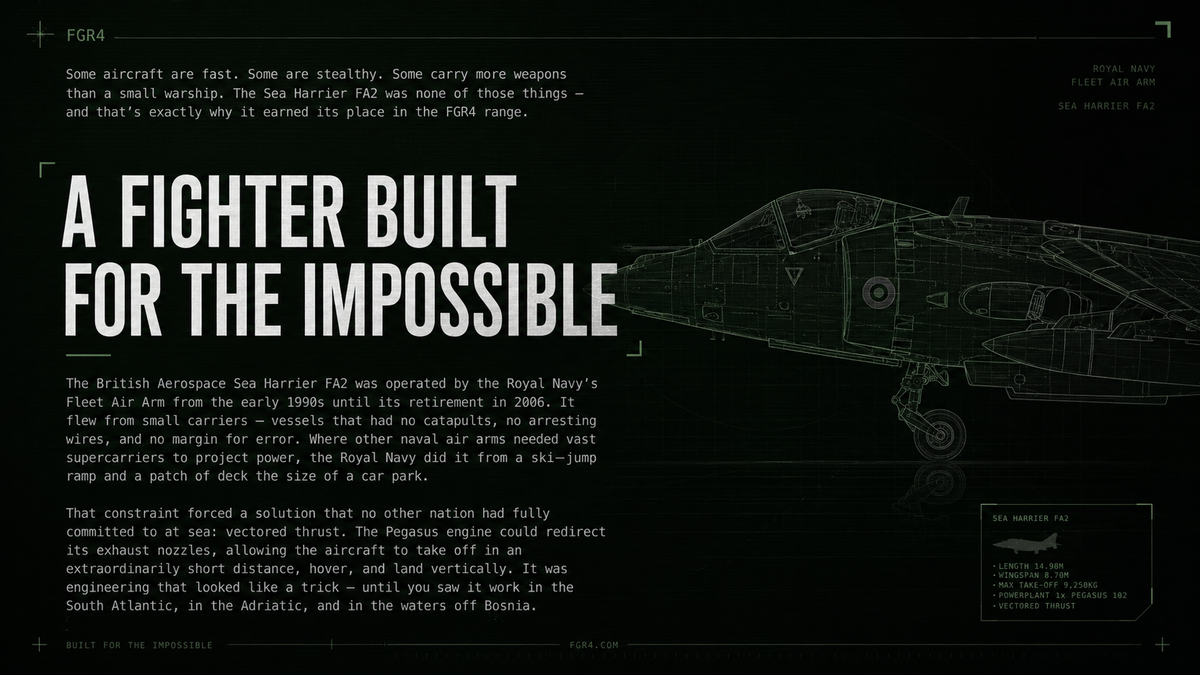
Some aircraft are fast. Some are stealthy. Some carry more weapons than a small warship. The Sea Harrier FA2 was none of those things — and that's exactly why it earned its place in the FGR4 range.
A Fighter Built for the Impossible
The British Aerospace Sea Harrier FA2 was operated by the Royal Navy's Fleet Air Arm from the early 1990s until its retirement in 2006. It flew from small carriers — vessels that had no catapults, no arresting wires, and no margin for error. Where other naval air arms needed vast supercarriers to project power, the Royal Navy did it from a ski-jump ramp and a patch of deck the size of a car park.
That constraint forced a solution that no other nation had fully committed to at sea: vectored thrust. The Pegasus engine could redirect its exhaust nozzles, allowing the aircraft to take off in an extraordinarily short distance, hover, and land vertically. It was engineering that looked like a trick — until you saw it work in the South Atlantic, in the Adriatic, and in the waters off Bosnia.
The FA2 Upgrade: Teeth Behind the Trick
The original Sea Harrier FRS1 was a capable aircraft, but the FA2 variant transformed it into a genuine beyond-visual-range fighter. The Blue Vixen pulse-Doppler radar — one of the most advanced fitted to any British aircraft at the time — gave it the ability to track multiple targets simultaneously and guide the AIM-120 AMRAAM missile. Suddenly, the aircraft that had fought with Sidewinders over the Falklands could engage threats it couldn't even see.
It was a quiet revolution. No fanfare, no major procurement headlines. Just a small, carrier-based fighter quietly becoming one of the most capable air-to-air platforms in the Royal Navy's history.
Why It Belongs on a Desk Mat
At FGR4, we don't choose aircraft for nostalgia alone. We choose them because they represent something worth understanding — a design philosophy, an engineering decision, a moment where capability was wrung out of constraint.
The Sea Harrier FA2 is a perfect expression of that. Its blueprint silhouette — the distinctive anhedral wing, the raised cockpit, the four underwing pylons — tells a story of a machine designed to operate where others couldn't. The technical drawing format we use on our desk mats isn't decorative. It's a deliberate choice to show the aircraft as engineers saw it: as a system, a solution, a set of problems solved under pressure.
When you're working at your desk, you're doing the same thing. Solving problems. Operating under constraint. Finding the answer that fits the space you have.
That's the Sea Harrier. That's the desk mat. That's FGR4.
A Tribute to British Naval Aviation
The FA2 was retired in 2006 — a decision that remains controversial among those who flew it and those who studied it. The Royal Navy lost its fixed-wing carrier aviation capability for over a decade until the F-35B arrived aboard HMS Queen Elizabeth. In that gap, the Sea Harrier's legacy only grew.
Our Royal Navy Sea Harrier FA2 Desk Mat is a tribute to that legacy. It's for the people who know what the Blue Vixen radar was. For those who understand why vectored thrust matters. For anyone who appreciates that the most interesting engineering solutions are rarely the biggest or the loudest — they're the ones that do the most with what they have.
If that sounds like you, the desk mat is waiting.
FGR4 doesn't just follow aircraft. We build around capability.