
Some brands release products. Some chase trends. Some fill a store with anything that looks vaguely connected to aviation.
FGR4 was never built for that.
It was built around aircraft. Around capability. Around the idea that every platform has a reason to exist — and that reason should be visible in the design. The shape, the role, the markings, the engineering decisions, the operational history. Not decoration. Not generic aviation artwork. A system.
That is where FGR4 is heading next.
The Next Phase of the Range
The first FGR4 releases were about proving the format: aircraft-led desk mats, technical layouts, blueprint-inspired visuals, and a store that felt more like a mission interface than a standard product page.
Now the range is beginning to expand properly.
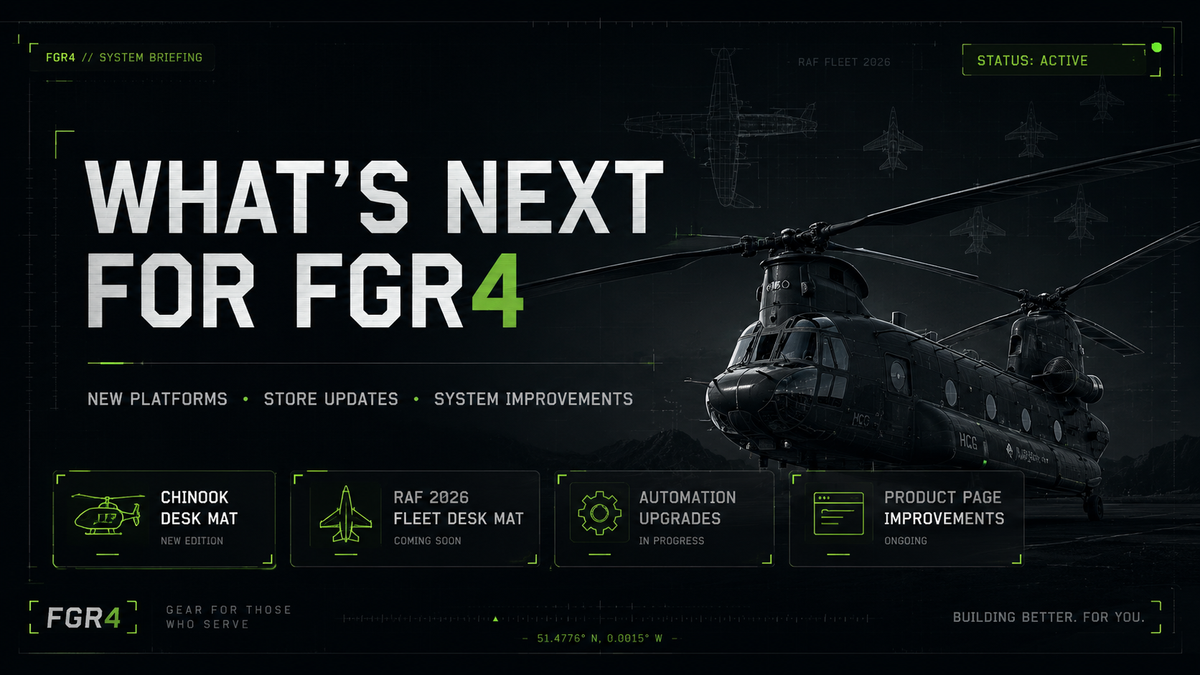
One of the next aircraft in development is the Royal Air Force Chinook HC6 — a platform that does not need to look sleek to be iconic. It is heavy-lift capability made visible. Twin rotors, a long fuselage, a brutal working silhouette, and decades of operational relevance behind it.
It is not the prettiest aircraft in the fleet. That is exactly why it works.
The Chinook has presence because every part of it has a job. The shape is dictated by purpose. The aircraft looks the way it does because it has to. That makes it a perfect fit for the FGR4 design language: functional, technical, instantly recognisable, and impossible to mistake for anything else.
Alongside that, work is also underway on a broader Royal Air Force 2026 Fleet Desk Mat — a more ambitious piece designed to bring multiple modern RAF platforms into one controlled visual system. Not just one aircraft. A wider view of the current force: fast jets, transport, surveillance, training, lift, and support.
The challenge with a fleet design is balance. Too much, and it becomes clutter. Too little, and it loses the weight of what it represents. The aim is to make something that feels like an operational overview: clean, precise, and built around the aircraft themselves.
More Than New Products
FGR4 is not just adding more designs. The system behind the brand is being rebuilt as well.
Product pages are being improved so each aircraft has more room to breathe. The goal is for every release to feel like a proper briefing: what the aircraft is, why it matters, how the design was built, and why it belongs in the range.
The news and blog section is becoming part of that too. This will not just be a place for announcements. It will be used for design notes, aircraft stories, release updates, range previews, and behind-the-scenes thinking from the FGR4 build process.
There are also quieter improvements happening in the background: better email flows, clearer customer updates, abandoned cart reminders, thank-you messages, and a more complete store experience from first visit to final delivery.
Not glamorous work. Necessary work.
The sort of work that makes the whole system sharper.
Why It Matters
Aviation design only works when it respects the aircraft.
That sounds obvious, but it is easy to get wrong. You can put a silhouette on a product and call it done. You can use random technical numbers, generic grid lines, and a few military-style words and hope it feels convincing.
FGR4 is trying to do something more deliberate.
Every aircraft added to the range has to earn its place. The Typhoon, the F-35B, the Atlas, the Chinook, and the wider RAF fleet concept all represent different forms of capability. Air superiority. Carrier strike. Heavy transport. Tactical lift. Training. Surveillance. Support.
Different aircraft. Different jobs. Same design discipline.
That is what the next phase is about: building a range that feels connected, not random.
Building the System Properly
FGR4 is still early, but the foundations are becoming stronger.
The store is being refined. The product pages are being upgraded. The release pipeline is becoming more structured. The designs are becoming more ambitious. The brand language is getting clearer with every aircraft added.
There will be more RAF platforms. More Royal Navy aviation. More technical artwork. More controlled releases. More reasons for each product to exist beyond “this aircraft looks cool”.
Because that was never enough.
FGR4 is not here to flood a store with aviation graphics. It is here to build around capability.
One aircraft at a time. One system at a time. One release at a time.
The next wave is already in motion.
FGR4 does not just follow aircraft.
We build around what they do.